
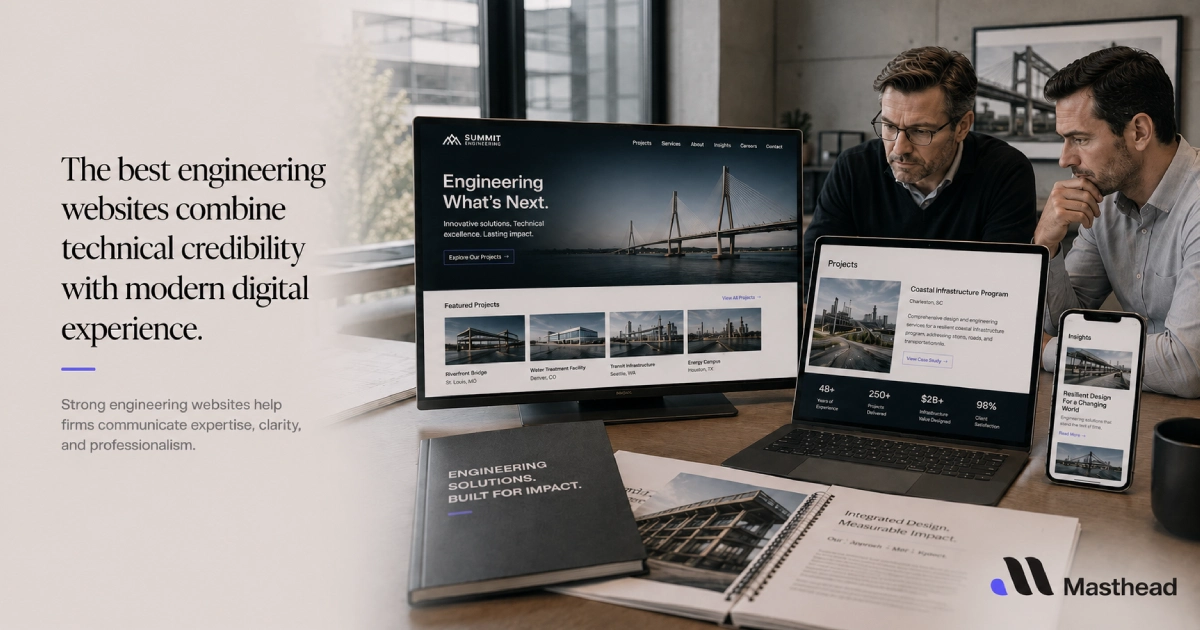
Best Engineering Firm Website Examples in 2026 (And What Makes Them Effective)
Engineering firms are responsible for designing and delivering some of the most important infrastructure, facilities, and systems in the world.
They solve highly technical problems, manage complex projects, and often work on assignments that carry significant financial, operational, and public impact.
Yet when potential clients evaluate engineering firms online, technical expertise alone is rarely enough.
Before a proposal is requested or a meeting is scheduled, decision-makers are often forming opinions based on what they see on a firm’s website.
The reality is that many engineering firms have exceptional capabilities but struggle to communicate those capabilities effectively online.
The best engineering websites do something different.
They make expertise easier to understand. They make project experience easier to evaluate. And most importantly, they help potential clients feel confident that they are dealing with a capable, professional organization.
Rather than looking at specific firms, it is often more valuable to understand the characteristics that make today’s most effective engineering websites successful.
Because while industries, specialties, and project types may differ, the principles behind high-performing engineering websites remain remarkably consistent.
The Best Engineering Websites Focus on Buyer Confidence
Many firms assume visitors arrive at their website looking for technical information.
That is only partially true.
Most buyers are actually looking for confidence.
Whether the visitor is a developer, architect, municipality, healthcare organization, manufacturer, or facility owner, they are actively trying to answer a critical series of questions:
- Can this firm handle our project?
- Do they have relevant experience?
- Have they solved similar problems before?
- Will they be easy to work with?
- Can we trust their recommendations?
The most effective engineering websites are built around answering these questions. They recognize that expertise alone does not create trust — expertise must be communicated clearly. When visitors leave a website feeling more confident than when they arrived, the website has done its job.
Strong Project Storytelling Separates Great Websites From Average Ones
One of the biggest differences between average engineering websites and exceptional ones is how they present projects.
Many firms simply display a project name, location, and a few images. While this provides information, it does not communicate value.
The best engineering websites treat projects as stories. They explain:
- The challenge that existed
- The engineering solution developed
- The technical complexity involved
- The outcomes achieved
- The expertise required to deliver success
This context matters because engineering clients are often evaluating whether a firm has solved problems similar to their own. A well-structured case study helps visitors connect experience to future opportunities.
Rather than simply showing completed work, it demonstrates capability. This approach is a key component of effective engineering website design that showcases expertise online
Clear Positioning Makes Engineering Firms Easier to Understand
One reason many engineering websites struggle is that they try to be everything to everyone.
Visitors encounter broad statements about engineering excellence, innovation, and quality service. What they often do not encounter is clarity.
The strongest engineering websites quickly establish:
- What the firm specializes in
- Which industries it serves
- What types of projects it handles
- Where its expertise is strongest
A transportation engineering firm should not sound identical to an MEP consultant. A structural engineering practice should not communicate the same way as a civil infrastructure firm.
Clear positioning helps visitors understand where the firm fits within the marketplace. That clarity improves both trust and lead quality.
Great Engineering Websites Balance Technical Depth With Accessibility
Engineering firms face a unique challenge.
They need to demonstrate technical expertise without overwhelming visitors.
Many websites struggle with this balance. Some become so technical that only engineers understand the content. Others simplify everything so much that they fail to demonstrate expertise.
The most effective engineering websites strike a middle ground. They communicate complex concepts clearly without sacrificing credibility.
Technical decision-makers can still find the depth they need, while non-technical stakeholders can understand the value being delivered.
This balance is one of the defining characteristics of strong engineering marketing.
Modern Design Supports Credibility
Engineering is fundamentally about precision, organization, and problem-solving.
Visitors often expect a website to reflect those same qualities.
That does not mean engineering websites need flashy animations or dramatic visual effects. In fact, many of the strongest examples are relatively restrained.
What they do exceptionally well is create clarity.
Information is organized logically.
Navigation feels intuitive.
Visual design supports rather than distracts from the content.
The overall experience feels professional.
Modern design reinforces the perception that the firm is organized, capable, and detail-oriented. Firms struggling with outdated digital experiences often face the same challenges discussed in why engineering firm websites feel outdated.
Those qualities matter when clients are evaluating engineering partners.
The Best Websites Make Expertise Easy to Find
One common weakness in older engineering websites is that valuable information is often buried.
Visitors may need multiple clicks to discover project experience, service details, industries served, or leadership information.
Modern websites remove that friction. They make it easy to access:
- Project portfolios
- Technical specialties
- Industry expertise
- Team profiles
- Contact information
- Thought leadership content
The easier it is for visitors to find relevant information, the more likely they are to remain engaged. Strong websites guide visitors rather than forcing them to search. Many firms also improve engagement through clean, responsive, conversion-oriented website design principles.
Thought Leadership Has Become a Competitive Advantage
Engineering firms are increasingly competing on expertise rather than simply services.
As a result, many of the strongest websites include educational content that demonstrates industry knowledge.
Examples include:
- Technical insights
- Industry trends
- Regulatory updates
- Design considerations
- Project planning guidance
- Engineering best practices
This content serves multiple purposes.
It improves search visibility.
It supports trust-building.
And it positions the firm as a knowledgeable resource.
In many cases, thought leadership helps establish credibility before a direct conversation ever takes place.
Mobile Experience Is No Longer Optional
The stereotype of engineering clients sitting behind desks all day no longer reflects reality.
Project owners, developers, architects, and facility managers frequently access websites from mobile devices. They may be traveling, attending meetings, visiting project sites, or reviewing vendors between appointments.
A poor mobile experience creates unnecessary friction. The best engineering websites perform consistently across:
- Smartphones
- Tablets
- Laptops
- Desktop computers
Mobile usability is now part of professionalism. Visitors expect websites to work seamlessly regardless of device. This is why responsive web design and strong mobile page speed performance are essential components of modern engineering websites.
Recruiting Is Influencing Website Strategy
The competition for engineering talent continues to intensify. As a result, many engineering firms are using their websites not only to attract clients but also to attract employees.
Potential candidates often evaluate firms online before applying. They want to understand:
- Company culture
- Leadership
- Career opportunities
- Types of projects
- Growth potential
- Technical challenges
The strongest engineering websites recognize that recruiting and business development often overlap. Similar to how a modern website can help attract and retain top talent, engineering firms can use their digital presence to strengthen employer branding and support hiring efforts.
What Today’s Best Engineering Websites Have in Common
Despite differences in size, specialty, and market focus, the strongest engineering websites share several characteristics:
- They communicate expertise clearly
- They showcase meaningful project experience
- They position the firm effectively within its market
- They make information easy to access
- They support both visibility and credibility
- They help visitors feel confident
That confidence is what ultimately drives conversations, proposals, and business opportunities. Strong websites also include strategic calls-to-action that support conversions so visitors always know what step to take next.
Lessons Engineering Firms Can Apply Immediately
A firm does not need a complete redesign to improve its website. Often, meaningful improvements begin with simple questions:
- Does the website clearly explain what we specialize in?
- Can visitors easily find relevant project experience?
- Are we communicating expertise through proof rather than claims?
- Does the website reflect who we are today rather than who we were five years ago?
- Would a potential client leave the site feeling more confident?
The answers to those questions often reveal the biggest opportunities.
Final Thoughts
The best engineering firm websites in 2026 are not necessarily the most visually impressive — they are the most effective communicators. They translate technical expertise into trust, make complex capabilities easier to understand, and help buyers evaluate confidence.
As engineering firms continue competing for both projects and talent, websites will play an increasingly important role in shaping perception.
The firms that invest in communicating their expertise effectively online will be better positioned to earn trust, attract opportunities, and differentiate themselves in competitive markets. To learn more, visit the Masthead Technology website or contact the team.
FAQs
What makes a great engineering firm website?
A great engineering website combines clear positioning, strong project storytelling, modern usability, technical credibility, thought leadership, and easy access to relevant information.
Why are project case studies important for engineering firms?
Case studies help demonstrate expertise, problem-solving ability, and relevant experience, making it easier for potential clients to evaluate the firm’s capabilities.
Do engineering firms need thought leadership content?
Yes. Educational content helps establish authority, improve search visibility, and build trust with prospective clients.
How does website design affect engineering firms?
Website design influences credibility and first impressions. A professional, organized website reinforces the perception that the firm is capable and detail-oriented.
Why is mobile optimization important for engineering websites?
Many decision-makers research engineering firms from mobile devices. A strong mobile experience improves usability, engagement, and trust.