
Engineering firms are responsible for some of the most sophisticated work in the modern world.
They design bridges, transportation systems, healthcare facilities, manufacturing plants, utilities, data centers, and critical infrastructure that communities depend on every day.
Their teams solve complex technical problems, manage massive projects, and deliver solutions that require years of expertise.
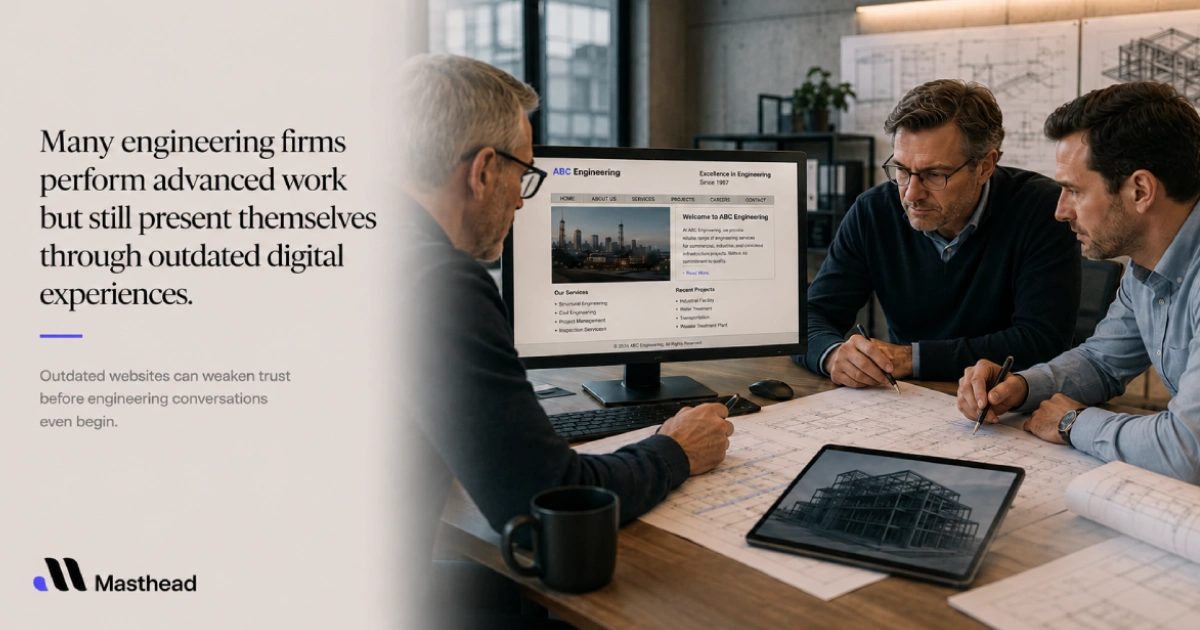
Yet many engineering firms present themselves online through websites that fail to reflect that level of capability.
This creates an increasingly common disconnect.
A highly skilled, technically advanced engineering firm may appear outdated, difficult to understand, or less credible than competitors simply because its website no longer matches modern expectations.
In 2026, that gap matters more than many firms realize.
Before a proposal request, before a discovery meeting, and often before a referral conversation, potential clients are evaluating engineering firms online.
The question is no longer whether an engineering website needs to exist.
The question is whether it accurately represents the expertise behind the business.
Engineering Firms Have Evolved Faster Than Their Websites
Many engineering websites were built years ago when expectations were different.
At the time, having a professional website was often enough.
A simple navigation structure, a list of services, and a few project examples were considered sufficient.
The engineering firm continued to grow.
New markets were entered.
New specialties were added.
Teams expanded.
Projects became larger and more sophisticated.
But the website often remained largely unchanged.
Over time, the company evolved while its digital presence stayed frozen in an earlier version of the business.
As a result, visitors frequently encounter websites that no longer reflect the firm’s true capabilities.
The website may describe a regional engineering company from 2016 while the organization itself operates like a much larger, more advanced business in 2026.
Modern Buyers Expect More Than a List of Services
The way engineering firms are evaluated has changed significantly.
Potential clients are no longer satisfied with simply seeing a list of services and contact information.
Developers, municipalities, healthcare organizations, manufacturers, architects, and facility owners want deeper insight.
They want to understand:
- What types of projects the firm specializes in
- Which industries it serves
- How complex its work is
- What experience the team brings
- Whether the firm has solved similar challenges before
The result is a website that informs but does not persuade. The strongest firms follow many of the same principles discussed in best engineering firm website examples where expertise and specialization are communicated clearly.
Technical Expertise Is Often Hidden Behind Generic Messaging
One of the biggest challenges in engineering marketing is communicating expertise clearly.
Many firms possess extraordinary technical knowledge but struggle to translate it into language that resonates with decision-makers.
As a result, websites become filled with vague phrases such as:
- “Innovative engineering solutions.”
- “Trusted industry expertise.”
- “Commitment to excellence.”
While these statements sound professional, they reveal very little about what makes the firm unique.
The strongest websites follow proven engineering website design strategies that showcase technical expertise through project experience, industry focus, and measurable outcomes.
A potential client evaluating multiple engineering firms often sees nearly identical messaging across competing websites.
This creates a problem.
If every company sounds the same, differentiation disappears.
The strongest engineering websites communicate expertise through specificity.
They explain project types, industries served, technical capabilities, and real-world outcomes.
They help visitors understand exactly why the firm is qualified to solve a particular challenge.
Engineering Websites Often Focus on the Firm Instead of the Client
Many older websites are organized around internal company information rather than client needs.
Visitors encounter lengthy descriptions about the firm’s history, organizational structure, and credentials before they ever learn how the company can help them.
While company background is important, buyers are usually asking a different question:
“Can this firm solve our problem?”
Modern websites address that question immediately.
They focus on challenges, outcomes, industries, and project experience.
Rather than asking visitors to interpret technical capabilities themselves, they explain those capabilities in ways that feel relevant and meaningful.
The most effective engineering websites are designed around the buyer’s decision-making process, not the firm’s organizational chart.
Weak Project Presentation Reduces Credibility
Engineering is a proof-driven profession.
Experience matters.
Project history matters.
Technical capability matters.
Yet many engineering websites present projects in ways that fail to communicate their significance.
Visitors may see a project image, a project name, and a short description.
What they often do not see is the story behind the work.
Potential clients want to understand:
- What challenge existed
- What solution was developed
- What expertise was required
- What outcomes were achieved
Without that context, even impressive projects can lose much of their impact.
The strongest engineering websites transform projects into case studies.
They demonstrate expertise rather than simply claiming it.
Outdated Design Creates Unnecessary Doubt
An outdated website does not mean an engineering firm is outdated.
However, visitors frequently make that association.
When a website feels old, cluttered, or difficult to navigate, it can create subtle concerns about the organization itself.
Potential clients may begin wondering:
- Is the firm keeping pace with industry changes?
- Are their systems modern?
- Do they invest in innovation?
- Are they growing or standing still?
These assumptions may be completely inaccurate.
Yet perception often influences decision-making.
A modern website helps align the firm’s digital presence with the sophistication of its engineering capabilities.
Mobile Experience Has Become a Business Requirement
Engineering decision-makers are not always sitting behind office desks.
Project owners, architects, facility managers, and development teams frequently review engineering firms while traveling, attending meetings, or visiting project sites.
Mobile usability has therefore become increasingly important.
Unfortunately, many older engineering websites were not designed with mobile users in mind.
Navigation becomes difficult.
Technical information becomes hard to read.
Contact forms become frustrating to use.
A poor mobile experience creates friction at the exact moment when buyers are evaluating options. This is why responsive web design and strong mobile performance have become essential requirements for modern engineering firms.
Modern websites eliminate that friction.
Recruiting Challenges Are Making Websites More Important
Engineering firms are competing for talent just as aggressively as they compete for projects.
Skilled engineers, project managers, designers, and technical specialists often research firms before applying for positions.
An outdated website can unintentionally send the wrong message.
Potential candidates may question:
- Company culture
- Growth opportunities
- Innovation
- Leadership
- Professional development
Modern engineering websites increasingly serve as recruiting tools as well as business development tools. Similar to how modern websites help attract and retain top talent, engineering firms can use their websites to strengthen employer branding and support hiring efforts.
They help communicate who the company is and what it is like to work there.
Visibility Matters More Than Ever
Even the most impressive engineering website provides little value if nobody finds it.
Search visibility has become an increasingly important part of business development.
Organizations researching engineering services often begin with online searches.
Whether they are looking for structural engineers, civil engineering firms, MEP consultants, transportation specialists, or industrial engineering expertise, they frequently start online.
Many outdated engineering websites struggle because they were never built with modern SEO practices in mind.
As competitors invest in stronger digital strategies, firms with weak visibility become harder to discover.
That affects both awareness and opportunity generation.
What Modern Engineering Websites Do Differently
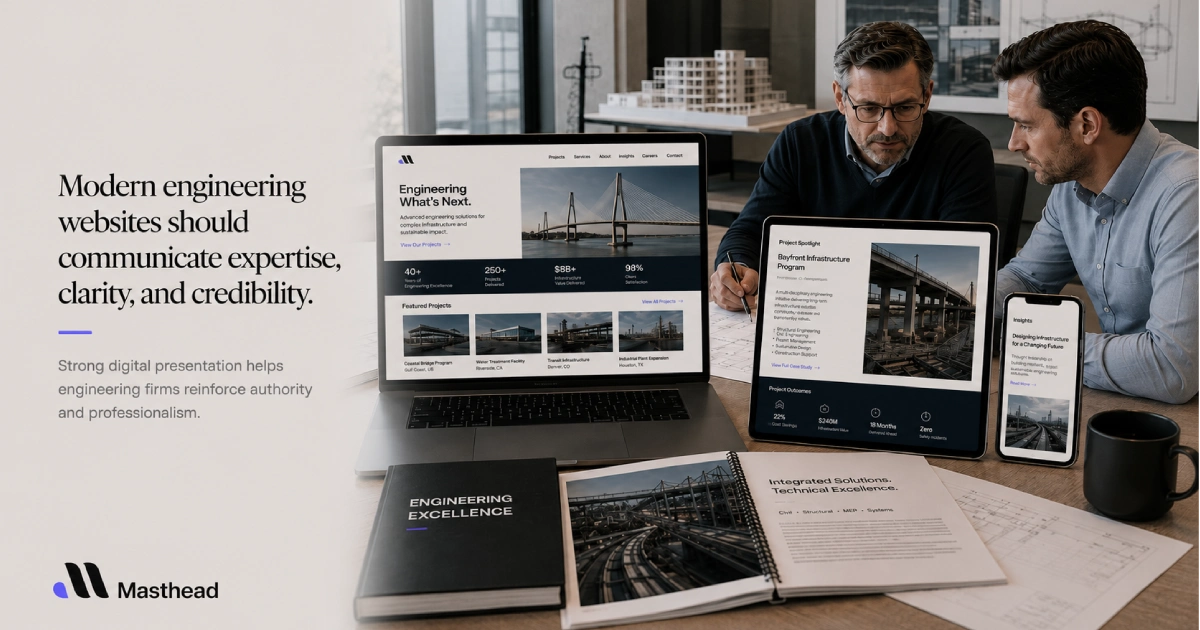
The strongest engineering websites are not necessarily the most visually dramatic.
What separates them is clarity.
They make it easy for visitors to understand:
- What the firm specializes in
- Who it serves
- What experience it brings
- Why clients trust it
- How to start a conversation
They combine technical credibility with accessibility. They showcase expertise without overwhelming visitors.
Most importantly, they reduce uncertainty.
Every page helps reinforce confidence in the firm’s ability to deliver. They also incorporate strong navigation, user experience, and conversion-oriented website design principles to help visitors engage with the firm more easily.
Final Thoughts
Engineering firms rarely struggle because they lack expertise.
More often, they struggle because their websites fail to communicate that expertise effectively.
An outdated website creates a disconnect between the quality of the firm’s work and the way it is perceived online.
In 2026, that disconnect can influence credibility, visibility, recruiting, and business development.
The most successful engineering firms recognize that their website is no longer simply a digital brochure.
It is often the first opportunity to demonstrate professionalism, capability, and trust.
Firms that invest in closing the gap between their expertise and their digital presence are positioning themselves to compete more effectively in an increasingly digital marketplace.
If visitors are ready to discuss a project or website modernization initiative, a clear path to contact the team should always be available.
FAQs
Why do so many engineering firm websites feel outdated?
Many engineering websites were built years ago and have not evolved alongside the firm’s growth, capabilities, branding, or buyer expectations.
What makes an engineering website modern?
Modern engineering websites combine strong project storytelling, clear positioning, mobile usability, SEO optimization, professional branding, and user-focused content.
Why are project case studies important for engineering firms?
Case studies help demonstrate technical expertise, problem-solving ability, industry experience, and successful project outcomes.
Can an outdated website affect business development?
Yes. Potential clients often evaluate engineering firms online before making contact, and outdated websites can reduce confidence and credibility.
How often should engineering firms redesign their website?
Most engineering firms should evaluate their website every three to five years to ensure it reflects current capabilities, branding, technology, and user expectations.