
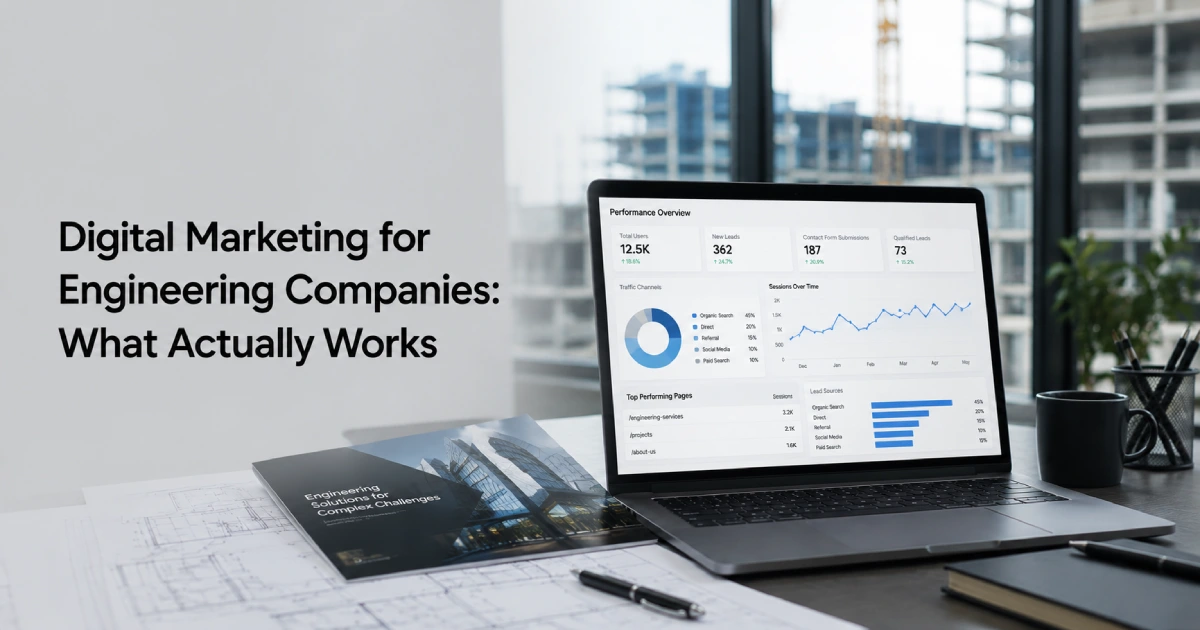
Digital Marketing for Engineering Companies: What Actually Works in 2026?
For many engineering firms, marketing has traditionally been driven by relationships rather than campaigns.
Projects come from referrals, repeat clients, networking, industry events, and long-established reputations. Those channels continue to be extremely valuable, particularly in an industry where trust and technical expertise play such a significant role in purchasing decisions.
However, the buying process has changed.
Before contacting an engineering firm, decision-makers almost always conduct their own research. They visit websites, compare firms, review projects, search Google, check LinkedIn, and evaluate whether a company appears capable of delivering the work.
This means digital marketing is no longer about replacing referrals. It’s about supporting them.
A well-executed digital marketing strategy helps engineering firms become easier to find, easier to evaluate, and easier to trust. The firms seeing the greatest success in 2026 understand that digital marketing is less about promotion and more about demonstrating expertise.
Digital Marketing Starts With a Strong Website
Every marketing activity eventually leads back to one place: your website.
Whether a prospective client finds your firm through Google, LinkedIn, an industry directory, a referral, or an email, they will almost always visit your website before making contact.
That makes your website the foundation of every digital marketing effort. It should clearly answer questions such as:
- What engineering services do you provide?
- Which industries do you specialize in?
- What types of projects have you completed?
- Why should someone choose your firm?
- How can they start a conversation?
If the website fails to answer those questions, even the best marketing campaigns will struggle to produce meaningful results.
Search Visibility Helps You Enter More Conversations
One of the most valuable aspects of digital marketing is increasing visibility during the research phase. Organizations looking for engineering partners often begin with search engines.
They may search for:
- Structural engineering consultants
- Civil engineering firms
- MEP engineering companies
- Transportation engineering services
- Environmental engineering experts
If your firm consistently appears during these searches, you’re more likely to be considered before a shortlist is created.
Search engine optimization (SEO) is therefore one of the most important long-term digital marketing investments an engineering firm can make. Leveraging targeted construction SEO services ensures your technical capabilities are highlighted directly to decision-makers searching online.
Rather than interrupting potential clients with advertising, search visibility helps your firm appear when organizations are actively looking for solutions.
Educational Content Builds Authority
Engineering is built on expertise, and digital marketing should reflect that.
Instead of focusing exclusively on selling services, successful engineering firms publish content that helps prospective clients make better decisions.
Examples include:
- Design considerations for commercial developments.
- Common infrastructure planning challenges.
- Building code updates.
- Sustainable engineering practices.
- Engineering project timelines.
- Site development best practices.
Educational content demonstrates technical knowledge while building trust. It also improves search engine rankings by answering questions prospective clients are already searching for.
For a deeper breakdown of these strategies, read our full guide on SEO for engineering firms to see how technical publishing directly impacts organic reach.
LinkedIn Has Become a Key Marketing Channel
Unlike many B2C industries, engineering marketing often targets professionals rather than broad consumer audiences. That makes LinkedIn particularly valuable.
Engineering firms can use LinkedIn to:
- Share project announcements.
- Publish technical articles.
- Highlight company milestones.
- Introduce team members.
- Showcase thought leadership.
- Strengthen relationships with industry professionals.
Consistent activity helps keep the firm visible between project cycles while reinforcing expertise and credibility. Rather than treating LinkedIn as another social media platform, successful firms use it as an extension of their professional reputation.
Project Case Studies Are Powerful Marketing Assets
One of the most persuasive forms of marketing isn’t advertising—it’s evidence.
Project case studies allow engineering firms to demonstrate how they solve real-world challenges.
Instead of simply stating that your firm has experience, a case study explains:
- The client’s objectives.
- Technical challenges.
- Engineering approach.
- Project outcomes.
- Lessons learned.
These stories help prospective clients understand how your expertise applies to projects similar to their own. They also provide valuable content for your website, sales conversations, proposals, and LinkedIn posts.
Email Marketing Keeps Relationships Alive
Engineering projects often have long planning cycles. A prospect who visits your website today may not begin a project for another six months. Email marketing helps maintain visibility during that period.
Rather than sending promotional messages, engineering firms can share:
- Industry insights.
- Regulatory updates.
- New project announcements.
- Technical articles.
- Company news.
- Upcoming events.
The objective isn’t immediate sales. It’s staying top of mind until the opportunity arises.
Online Reputation Influences Buying Decisions
Potential clients rarely rely on a company’s own marketing alone; they also look for independent validation.
Trust signals include:
- Client testimonials and reviews.
- Industry awards and professional certifications.
- Published articles and conference presentations.
- Professional memberships and affiliations.
Digital marketing should highlight these trust signals throughout the website and other online channels. The goal is to reinforce the firm’s reputation with tangible proof rather than marketing claims.
Paid Advertising Works Best With Specific Goals
Many engineering firms assume digital marketing automatically means running Google Ads. Paid advertising certainly has its place, but it should support a broader strategy rather than replace it.
Advertising works well for:
- Launching new service lines.
- Expanding into new markets.
- Recruiting engineers.
- Promoting industry events.
- Increasing visibility for specialized services.
However, advertising is most effective when it directs visitors to a website that already communicates expertise and credibility.
Without that foundation, advertising often produces poor-quality inquiries.
Consistency Matters More Than Volume
One of the biggest mistakes firms make is treating digital marketing as a series of isolated campaigns: a website update here, a LinkedIn post there, and an occasional blog article.
The strongest engineering firms market consistently. That doesn’t necessarily mean producing massive amounts of content; it means maintaining a steady, professional presence.
Regular website updates, new case studies, educational articles, and project announcements gradually build authority over time. Consistency creates momentum.
Digital Marketing Supports Recruiting Too
Marketing isn’t only about attracting clients; engineering firms also compete for highly skilled professionals.
Potential employees evaluate firms in much the same way prospective clients do. They visit the website, review recent projects, explore company culture, and assess whether the organization appears modern and professionally managed.
Strong digital marketing therefore supports both business development and recruitment. The same content that attracts clients often attracts future engineering talent as well.
What Successful Engineering Firms Do Differently
The firms seeing the greatest success online share several characteristics:
- They invest in SEO.
- They publish educational content.
- They showcase meaningful project experience.
- They maintain an active LinkedIn presence.
- They continuously update their website as the business grows.
Most importantly, they focus on building trust rather than simply generating traffic. Partnering with specialists like Masthead Technology can help align these strategies with measurable growth goals.
Final Thoughts
Digital marketing for engineering companies is no longer optional. As buyer behavior becomes increasingly digital, firms need a professional online presence that reflects the quality of their expertise.
The most effective strategies focus on visibility, education, credibility, and consistency. When supported by a modern website, strong project case studies, educational content, and search visibility, digital marketing becomes an extension of the firm’s reputation rather than a separate business function.
Engineering firms that embrace this approach will be better positioned to attract qualified clients, strengthen relationships, and grow sustainably in the years ahead.
Ready to modernize your firm’s online presence? Feel free to contact our team to discuss your strategy.
FAQs
What is the best digital marketing strategy for engineering firms?
The most effective strategy combines a strong website, SEO, educational content, project case studies, LinkedIn marketing, and ongoing reputation building.
Should engineering companies use social media?
Yes, particularly LinkedIn. It is one of the best platforms for sharing expertise, showcasing projects, and maintaining visibility with clients and industry professionals.
Is paid advertising necessary for engineering firms?
Not always. Paid advertising can be effective for promoting specialized services, recruiting talent, or entering new markets, but it works best when supported by a strong website and SEO strategy.
Why is content marketing important for engineering firms?
Educational content demonstrates expertise, builds trust, improves search visibility, and helps potential clients discover your firm during the research stage.
How does digital marketing support business development?
Digital marketing increases visibility, reinforces credibility, showcases expertise, and helps engineering firms stay top of mind throughout the long decision-making process common in engineering projects.