
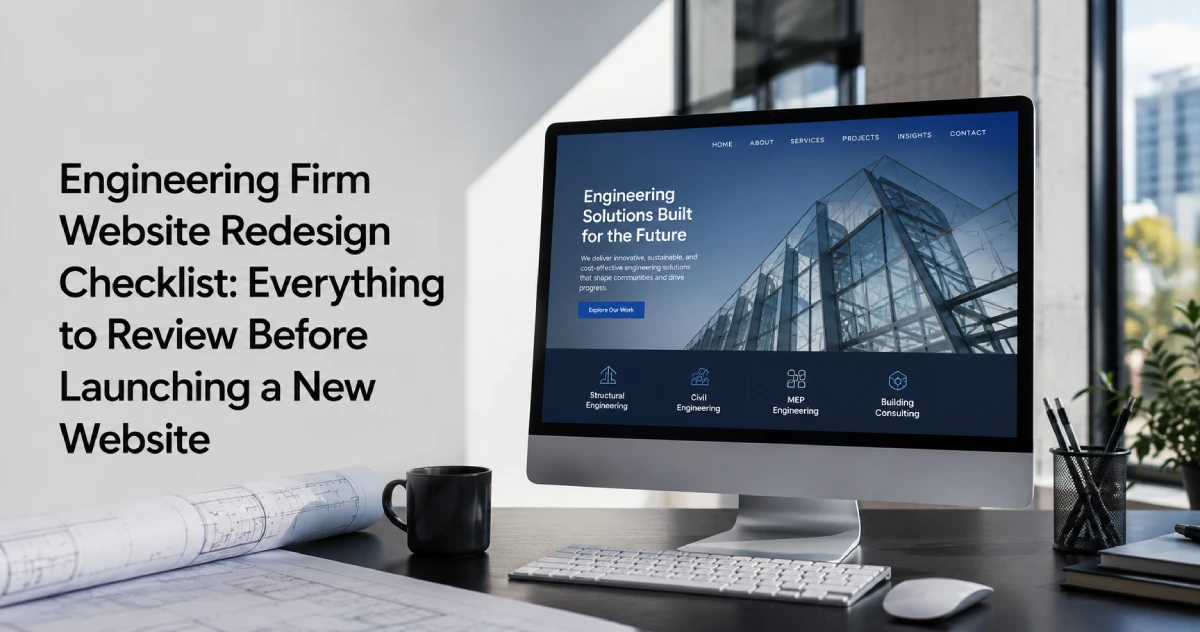
Engineering Firm Website Redesign Checklist: Everything to Review Before Launching a New Website
An engineering firm’s website should evolve as the business evolves.
New service lines are introduced. Teams grow. Markets expand. Larger and more complex projects are completed. Client expectations change. Search engines update the way they rank websites.
Yet many engineering firms continue using websites that were built five, seven, or even ten years ago.
The result is often a disconnect between the firm’s capabilities and the way it presents itself online.
A website redesign is an opportunity to close that gap.
However, redesigning an engineering website involves much more than updating colors, choosing new fonts, or replacing old photographs.
A successful redesign improves how prospective clients understand your expertise, how easily they find your firm online, and how confidently they decide to contact you.
Before launching a new website, there are several areas every engineering firm should review.
Start With Business Goals, Not Design
Many redesign projects begin with discussions about appearance.
While visual design is important, it should never be the starting point. It helps to review why engineering firm websites feel outdated before jumping straight into layout discussions.
Instead, begin by asking larger business questions:
- Has the firm expanded into new industries?
- Are there services that deserve greater visibility?
- Is recruiting now a priority?
- Are you targeting larger or more specialized projects?
- Has your positioning changed since the current website was launched?
The answers should shape the website’s structure and messaging long before anyone begins discussing layouts or color palettes. A redesign should support where the business is going, not simply improve how it looks today.
Review Your Website Structure
One of the biggest opportunities during a redesign is improving site architecture.
Many engineering firms gradually add pages over the years without a clear plan. As a result, navigation becomes cluttered, information is difficult to find, and visitors struggle to understand the firm’s capabilities. You can explore some of the best engineering firm website examples in 2026 to see how industry leaders structure their navigation.
Before building a new site, review whether your website includes dedicated pages for:
- Engineering services
- Industries served
- Project case studies
- Company information
- Leadership team
- Careers
- Resources or insights
- Contact information
Visitors should be able to reach important information with minimal effort. A logical structure also helps search engines understand the relationship between different topics on your website.
Evaluate Your Service Pages
One-page service summaries are rarely enough in 2026. Custom website design services ensure each discipline gets the space it requires to convert prospects.
Each major engineering discipline should have its own dedicated page that explains:
- The services provided.
- Typical project types.
- Industries served.
- Relevant experience.
- Common client challenges.
- Frequently asked questions.
These pages help prospective clients evaluate your expertise while strengthening your visibility in search engines. If your website combines multiple engineering disciplines into a single page, a redesign is the ideal time to separate them. Avoiding common engineering website design mistakes at this stage saves significant technical debt down the road.
Upgrade Project Pages Into Case Studies
Projects are often the most valuable content on an engineering website.
Unfortunately, they are also one of the most underutilized. Effective engineering website design to showcase expertise online relies on presenting past work clearly.
Rather than simply displaying project photos, use the redesign as an opportunity to create meaningful case studies. Each project should explain:
Each project should explain:
- The client’s objectives.
- The engineering challenge.
- Your technical approach.
- Key project outcomes.
- Lessons learned.
Case studies allow prospective clients to understand not only what your firm has done but how your team solves complex problems. That context builds confidence.
Review Your Messaging
One of the easiest mistakes to carry into a new website is old messaging.
Many engineering firms rely on broad statements such as:
- “Innovative engineering solutions.”
- “Commitment to excellence.”
- “Trusted engineering partner.”
While these phrases sound professional, they rarely explain why a prospective client should choose your firm.
During a redesign, review every page and ask: Does this content clearly explain what makes our firm different?
Specificity almost always creates more credibility than generic marketing language.
Refresh Visual Content
Nothing dates an engineering website faster than outdated imagery.
Old office photos, low-resolution project images, or pictures that no longer represent the firm’s work can unintentionally weaken credibility. A redesign is the perfect opportunity to update:
- Project photography.
- Team photos.
- Office images.
- Drone photography.
- Process diagrams.
- Infographics.
Visuals should accurately reflect the scale, professionalism, and quality of the projects your firm delivers today.
Improve Mobile Experience
Many engineering websites were originally designed for desktop users. Today’s decision-makers often browse websites while travelling, attending meetings, or visiting project sites. Incorporating modern website features for engineering companies ensures a seamless user interface on any screen size.
Before launching, review your website on multiple devices. Pay particular attention to:
- Navigation.
- Readability.
- Contact forms.
- Project galleries.
- Downloadable documents.
- Page speed.
A seamless mobile experience is now a basic expectation rather than a competitive advantage.
Build SEO Into the Redesign
Search engine optimization should never be treated as something that happens after launch—it should be considered from the beginning. Implementing dedicated construction SEO services during development guarantees your structure is built for visibility.
Review whether your new website includes:
- Dedicated service pages.
- Industry pages.
- Location pages where appropriate.
- Optimized page titles and descriptions.
- Internal linking.
- Logical URL structure.
- Schema markup.
- Fast-loading pages.
Deepening your knowledge on SEO for engineering firms will help ensure your site structure captures valuable search demand. Building SEO into the redesign is significantly easier than trying to retrofit it later.
Strengthen Trust Signals
Every engineering website should provide clear evidence of credibility. Ask yourself whether visitors can easily find:
- Professional certifications.
- Industry memberships.
- Client testimonials.
- Awards.
- Leadership biographies.
- Years of experience.
- Safety commitments.
- Project statistics.
These trust signals help reduce uncertainty throughout the buying process. Rather than collecting them on a single page, distribute them naturally across the website.
Don’t Forget Recruitment
Many engineering firms redesign their website with prospective clients in mind but overlook another important audience: future employees.
A modern careers section should communicate:
- Company culture.
- Career development opportunities.
- Benefits.
- Graduate programs.
- Types of projects employees work on.
- Why engineers enjoy working at the firm.
Recruitment has become an important function of engineering websites, particularly in competitive hiring markets.
Test Before You Launch
One of the most overlooked parts of a redesign is testing. Before publishing the new website, review every important user journey:
- Can visitors quickly find services?
- Are project pages easy to navigate?
- Do contact forms work correctly?
- Are downloadable resources functioning?
- Do pages load quickly?
Testing helps identify problems before prospective clients encounter them. A polished launch creates a stronger first impression.
A Website Redesign Is More Than a Design Project
The most successful redesigns are not measured by how modern the website looks—they are measured by how effectively the website supports business goals.
A great engineering website should:
- Build trust.
- Showcase expertise.
- Improve search visibility.
- Support recruiting.
- Help prospective clients understand your capabilities.
- Make it easy to start a conversation.
Every design decision should support those objectives.
Final Thoughts
An engineering website redesign is an opportunity to rethink how your firm presents itself to the market.
Done well, it becomes far more than a visual refresh. Partnering with a specialized provider like Masthead Technology turns your digital presence into a stronger business development tool, a more effective recruiting platform, and a more accurate reflection of the expertise your organization delivers every day.
By reviewing your website strategically—not just aesthetically—you’ll create a digital presence that continues supporting your firm’s growth long after the redesign is complete.
Ready to upgrade your web presence? Feel free to contact our team today to discuss your website redesign goals.
FAQs
How often should engineering firms redesign their website?
Most firms should evaluate their website every three to five years to ensure it reflects current branding, technology, SEO best practices, and business goals.
What should be included in an engineering website redesign?
A redesign should review site structure, service pages, project case studies, SEO, mobile usability, messaging, trust signals, recruiting content, and technical performance.
Why are project case studies important?
Case studies demonstrate technical expertise and help prospective clients understand how your firm approaches complex engineering challenges.
Should SEO be included during a redesign?
Yes. SEO should be planned from the beginning to ensure the new website is structured for visibility and long-term growth.
Is website redesign only about improving appearance?
No. A successful redesign improves user experience, search visibility, credibility, lead generation, and how effectively the website supports overall business objectives.