
Why Most Construction Company Websites Fail (And What Successful Contractors Do Differently)
A construction company can have decades of experience, an impressive portfolio, a strong safety record, and a reputation built through years of successful projects. Yet many of these same companies are represented online by websites that fail to communicate any of those strengths.
This creates a growing problem in today’s market.
Before a developer requests a proposal, before a property owner schedules a meeting, and before a project manager picks up the phone, there is a good chance they will visit your website first.
For many construction firms, the website has quietly become part of the qualification process.
The challenge is that most contractor websites were never built for how commercial buyers evaluate companies today. They were built years ago, updated occasionally, and treated primarily as an online brochure rather than a business development tool.
As a result, many construction companies lose trust, visibility, and opportunities before conversations even begin.
Construction Buyers Research Differently Than They Did Ten Years Ago
Commercial buyers are under pressure to reduce risk.
Whether they are evaluating a general contractor, concrete contractor, sitework company, HVAC contractor, or specialty trade partner, they want confidence that the company they hire can execute successfully.
In the past, referrals often carried the entire decision-making process. Today, referrals are usually just the starting point.
Even when a contractor is recommended by a trusted source, buyers still conduct their own research. They visit websites, review project portfolios, compare competitors, look at company positioning, and evaluate whether the business appears capable of handling projects similar to theirs.
This means your website is no longer simply a marketing asset. It is often a credibility asset.
When a website feels outdated, confusing, or incomplete, buyers may begin questioning the company itself, even if the contractor has an excellent track record.
The Real Reason Most Construction Websites Fail
Most construction websites do not fail because they look bad.
They fail because they fail to answer the questions buyers are actually asking.
A project owner visiting a contractor’s website is not primarily interested in company history, mission statements, or generic marketing language.
Instead, they are trying to answer practical questions such as:
- Have they completed projects like ours?
- Do they understand our industry?
- Can they manage work at our scale?
- Are they organized and professional?
- Will they be easy to work with?
- Can we trust them with a significant investment?
Many websites never provide those answers clearly.
Instead, visitors encounter generic statements about quality, experience, and customer service that could apply to almost any contractor in the market.
The result is a website that looks acceptable on the surface but does very little to build confidence.
Outdated Design Creates Unnecessary Doubt
One of the fastest ways to lose trust is through an outdated website experience.
Many contractor websites were built five or ten years ago and have changed very little since then. While the company itself may have evolved significantly, the website often remains frozen in time.
An outdated design does not automatically mean a company is outdated. Unfortunately, buyers often make that connection anyway.
When visitors encounter old layouts, poor navigation, inconsistent branding, low-quality photography, or cluttered pages, they may assume the business is less sophisticated than competitors with stronger digital experiences.
This is particularly important for commercial contractors pursuing larger projects.
Developers, property managers, architects, and procurement teams increasingly expect a professional digital presence. They want to see evidence that a company operates with the same level of professionalism online that it demonstrates on project sites.
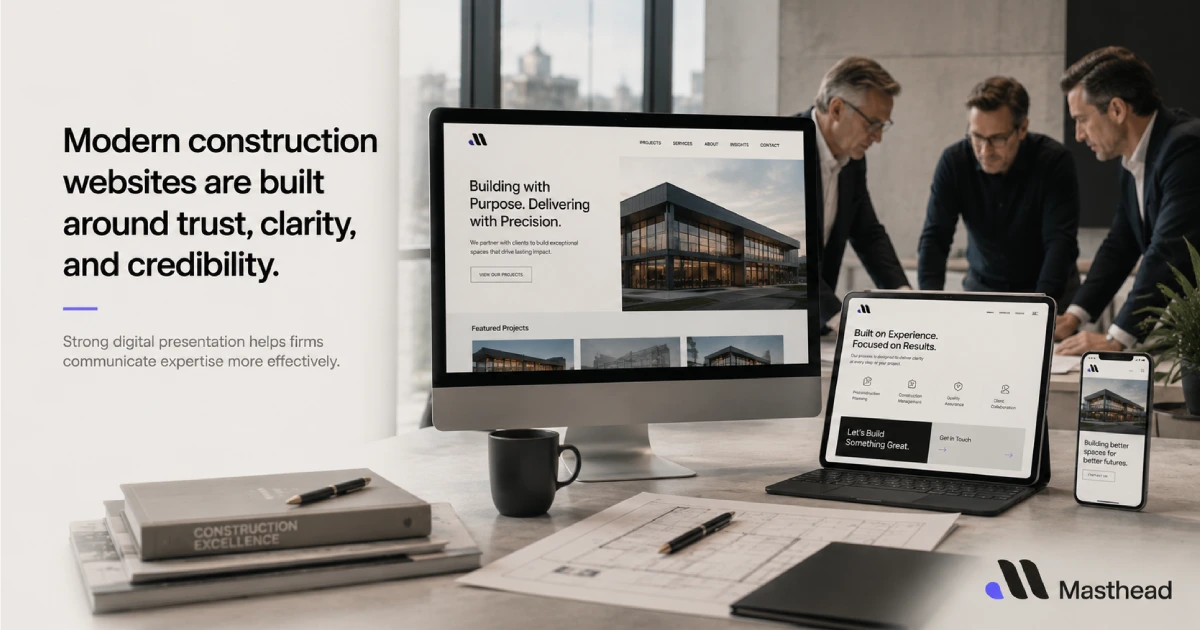
The strongest construction websites create confidence immediately. They feel organized, modern, and easy to navigate without being flashy or overdesigned. Many firms achieve this by investing in effective construction website designs that prioritize user experience and trust-building.
Weak Project Portfolios Leave Buyers Guessing
Construction is a proof-driven industry.
Unlike many businesses that sell ideas or concepts, contractors sell demonstrated capability. That is why project portfolios are often the most important section of a construction website.
Unfortunately, many firms treat portfolios as an afterthought.
Projects may be hidden deep within navigation, displayed through low-quality images, or listed without meaningful context. Visitors see a few photos but learn very little about the scope, complexity, or outcomes of the work.
Successful contractors take a different approach.
They use projects to tell stories.
Instead of simply showing finished work, they explain the challenges involved, the solutions delivered, the industries served, and the results achieved. This helps potential clients see themselves in similar projects and builds confidence that the contractor can handle comparable work.
A strong portfolio is not just visual proof. It is one of the most effective sales tools a construction company can have and is a key component of building effective construction company websites that generate qualified leads.
Generic Messaging Makes Contractors Blend Together
Visit enough contractor websites, and you begin to see the same phrases repeatedly.
“We provide quality workmanship.”
“We are committed to customer satisfaction.”
“We deliver exceptional service.”
While these statements are positive, they rarely differentiate one company from another.
Commercial buyers want specificity. They want to know whether a contractor specializes in healthcare construction, industrial facilities, municipal infrastructure, commercial concrete, or another niche.
They want to understand what types of projects the company performs best and what makes their approach different.
The most effective construction websites communicate this clearly.
Rather than trying to appeal to everyone, they focus on the clients and project types they serve best. That clarity creates stronger positioning and stronger trust. A well-planned construction web page design strategy helps communicate these differentiators more effectively.
Many Contractor Websites Ignore Mobile Users
Construction websites are no longer viewed only from office desktops.
Project managers browse websites from job sites. Developers review contractors while traveling. Decision-makers compare companies during meetings and site visits.
As a result, mobile traffic continues to grow across the construction industry.
Yet many contractor websites still provide poor mobile experiences.
Navigation becomes difficult. Text is hard to read. Forms are frustrating to complete. Important information is buried or inaccessible.
A poor mobile experience creates friction at the exact moment when buyers are evaluating options.
Successful contractors understand that usability is part of credibility. Their websites work just as effectively on a phone as they do on a desktop. Whether using a custom solution or evaluating custom construction website design vs template builders, mobile performance should remain a priority.
Visibility Matters as Much as Design
A well-designed website provides little value if potential clients never find it.
Many construction companies struggle with search visibility because their websites were never structured with SEO in mind.
Common issues include missing service pages, weak location targeting, poor internal linking, thin content, and limited industry-specific information.
As a result, competitors appear prominently in search results while experienced contractors remain invisible.
The strongest construction websites are built around both user experience and discoverability.
They help potential clients find the company while simultaneously building confidence once visitors arrive.
SEO and website strategy should work together rather than operate as separate initiatives. This approach is central to modern building construction website design practices that support long-term growth.
What Successful Contractors Do Differently
When we analyze high-performing construction websites, a pattern emerges.
Successful contractors tend to treat their websites as part of their business development process rather than simply an online brochure.
Their websites:
- Clearly communicate who they serve
- Showcase relevant project experience
- Build trust through case studies and proof
- Load quickly and perform well on mobile devices
- Make it easy for buyers to take the next step
- Support local and industry-specific SEO
- Reflect the professionalism of the company itself
Most importantly, they understand that buyers are evaluating more than services. They are evaluating confidence.
Every page, image, project, and message contributes to whether a visitor believes the company is capable, reliable, and worth contacting.
Construction Websites Are Now Part of Winning Work
The construction industry remains relationship-driven, but relationships increasingly begin online.
A website now influences how buyers perceive:
- professionalism
- operational maturity
- project capability
- communication quality
- trustworthiness
Companies that invest in stronger digital experiences are not simply improving marketing. They are improving how they compete.
For many contractors, the website has become one of the first opportunities to demonstrate credibility. Firms that recognize this are creating a meaningful advantage over competitors still relying on outdated digital experiences.
Final Thoughts
Most construction company websites fail because they were built for a different era.
They provide information but do not build confidence. They describe the company but fail to communicate value from the buyer’s perspective.
The most successful contractors understand that modern websites must do more than look professional.
They must demonstrate expertise, showcase relevant experience, reduce perceived risk, and help potential clients feel confident about starting a conversation.
In competitive construction markets, that difference matters more than ever.
Ready to improve your construction company’s online presence? Contact us or visit Masthead Technology to learn more about construction-focused website solutions.
FAQs
Why do so many construction company websites look outdated?
Many contractor websites were built years ago and have only received minor updates since then. While the company may have evolved significantly, the website often no longer reflects current branding, capabilities, or user expectations.
What makes a construction website effective?
An effective construction website combines modern design, strong project portfolios, clear positioning, mobile usability, trust signals, and SEO-friendly structure. It should help buyers quickly understand what the company does and why they should trust it.
Why are project portfolios important on contractor websites?
Project portfolios provide proof of experience and capability. They help potential clients evaluate project quality, industry expertise, and whether the contractor is a good fit for their specific needs.
Does SEO matter for construction companies?
Yes. Most commercial buyers research contractors online before reaching out. Strong SEO helps construction companies appear in relevant searches and generate qualified inquiries.
How often should construction companies update their website?
Most construction firms should review their website every three to five years to ensure it remains modern, secure, mobile-friendly, and aligned with current business goals.