
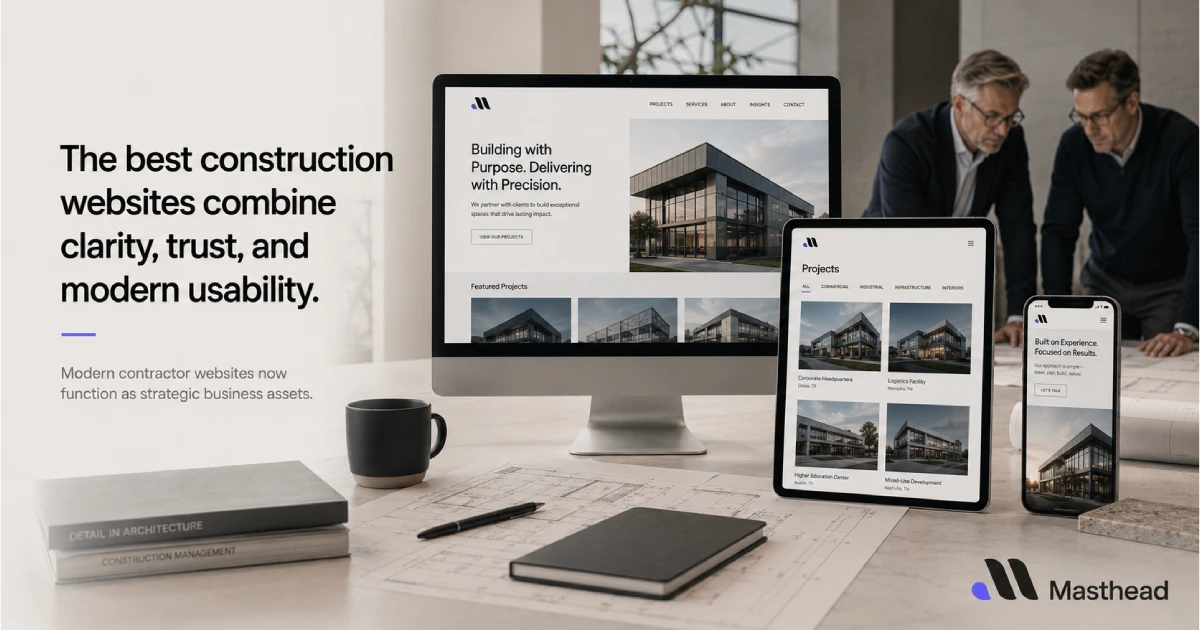
What Makes a Great Construction Website in 2026?
Not long ago, most construction company websites served a fairly simple purpose.
They provided a phone number, listed a few services, showed some project photos, and gave potential clients a way to get in touch. For many contractors, that was enough.
Today, however, buyer behavior has changed dramatically.
Developers, property managers, architects, municipalities, and commercial project owners often spend considerable time researching contractors online before initiating contact. They compare firms, review project experience, evaluate credibility, and form opinions long before a proposal request is submitted.
As a result, a construction company’s website has become far more than an online brochure.
It has become part of the sales process, part of the trust-building process, and increasingly, part of the competitive advantage that separates successful firms from those struggling to generate opportunities.
The question is no longer whether a construction company needs a website.
The question is what makes a construction website truly effective in 2026.
Great Construction Websites Build Confidence Before They Generate Leads
Many contractors focus on lead generation when evaluating website performance. While lead generation is important, it is often the result of something deeper.
Trust.
Before a visitor fills out a form, requests a proposal, or schedules a meeting, they must first feel confident in the company they are evaluating.
Commercial construction projects involve significant budgets, long timelines, and substantial risk. Buyers want reassurance that the contractor they choose has the experience, professionalism, and operational capability required to deliver successfully.
A great construction website reduces uncertainty. It answers questions before they are asked. It helps visitors understand who the company is, what types of projects it performs, and why it deserves consideration.
The strongest websites make visitors feel more confident by the time they leave than they did when they arrived. Many of the same trust-building principles are discussed in Why Most Construction Company Websites Fail, where credibility gaps often lead to missed opportunities.
Strong Positioning Is More Important Than Fancy Design
One of the biggest mistakes contractors make is believing that a great website is primarily about visual design.
Design matters, but positioning matters more.
Many construction websites look attractive but fail to clearly explain what the company actually does best.
Visitors should immediately understand:
- What type of construction work the company specializes in
- Which industries it serves
- What geographic markets it operates in
- What types of projects it is best suited for
- What differentiates it from competitors
A contractor specializing in healthcare facilities should not sound the same as a company focused on industrial construction or municipal infrastructure.
This clarity helps attract the right clients while filtering out opportunities that are not a good fit.
Project Portfolios Should Tell Stories, Not Just Show Photos
Construction remains one of the most visual industries in the world.
Clients want evidence.
They want proof that a contractor has completed projects similar to their own.
Yet many contractor websites still treat project portfolios as image galleries.
Visitors see photos but learn very little about the project itself.
Great construction websites go beyond visuals.
They explain:
- The scope of work
- Project challenges
- Technical requirements
- Industries served
- Outcomes achieved
- Unique expertise demonstrated
This transforms a portfolio from a collection of pictures into a powerful trust-building tool.
The best project pages help potential clients imagine their own project being completed successfully.
Mobile Experience Is No Longer Optional
A surprising number of construction websites still provide poor mobile experiences.
This is increasingly problematic because construction buyers are not always sitting behind desks.
They are often:
- Visiting job sites
- Traveling between meetings
- Reviewing contractors from mobile devices
- Comparing companies during active projects
When a website is difficult to navigate on a phone, confidence drops quickly.
A great construction website performs seamlessly across:
- Smartphones
- Tablets
- Laptops
- Desktop computers
Navigation should be simple. Pages should load quickly. Contact information should be easy to find. Forms should be effortless to complete.
Mobile usability is no longer a technical detail.
It is a credibility factor. Businesses investing in modern construction website design strategies typically prioritize mobile usability from the beginning.
Great Websites Make Expertise Easy to Understand
Construction companies often possess tremendous expertise but struggle to communicate it online.
Many websites rely on industry jargon, technical language, or vague marketing statements that fail to connect with buyers.
Great construction websites translate expertise into clarity.
Instead of overwhelming visitors with information, they help them quickly understand:
- What problems the company solves
- How projects are delivered
- Why the contractor is qualified
- What experience supports those claims
This balance between technical credibility and clear communication is one of the defining characteristics of modern construction websites. Strong construction web page design helps transform complex information into content that buyers can quickly understand.
Trust Signals Matter More Than Ever
Construction buyers are evaluating risk.
A great website actively helps reduce that risk.
The strongest contractor websites reinforce credibility through visible trust signals such as:
- Certifications
- Safety programs
- Industry affiliations
- Awards
- Client testimonials
- Case studies
- Project statistics
- Years of experience
- Leadership profiles
These elements help visitors feel reassured that they are dealing with a professional, established organization.
Without trust signals, even experienced contractors may appear less credible than they actually are.
Visibility Matters Just as Much as Design
Many construction companies invest heavily in design while overlooking search visibility.
Unfortunately, a beautiful website that nobody finds generates little value.
The best construction websites are built with SEO in mind from the beginning.
This includes:
- Service-specific pages
- Industry-focused content
- Local market optimization
- Clear site architecture
- Internal linking
- Technical SEO best practices
Strong visibility allows construction firms to appear when potential clients search for solutions online.
The website must perform well both for visitors and for search engines.
The two objectives are closely connected.
Great Construction Websites Guide Visitors Toward Action
One characteristic shared by almost every high-performing construction website is clarity.
Visitors always know what to do next.
Whether they want to:
- Request a proposal
- Schedule a consultation
- Review projects
- Contact the company
- Learn about services
The path is obvious.
Many contractor websites lose opportunities simply because they create friction.
Confusing navigation, hidden contact information, and unclear calls-to-action make it harder for visitors to engage.
The best websites remove obstacles rather than create them.
What Successful Contractors Understand
The most successful contractors no longer view their website as a marketing expense.
They view it as business infrastructure.
A modern construction website supports:
- Business development
- Recruiting
- Proposal credibility
- Brand positioning
- Search visibility
- Client education
- Lead generation
It becomes a resource that works continuously on behalf of the company.
When designed strategically, a website can help reinforce the same professionalism, expertise, and reliability that contractors demonstrate every day on their projects. Contractors planning a new site often benefit from understanding the process of website for a construction company.
Final Thoughts
A great construction website in 2026 is not defined by flashy animations, trendy design elements, or marketing buzzwords.
It is defined by its ability to build confidence.
The strongest websites communicate expertise clearly, showcase meaningful project experience, reduce uncertainty, and make it easy for potential clients to take the next step.
As buyers continue to research contractors online before initiating contact, websites will play an increasingly important role in determining which firms earn trust and which firms are overlooked.
For construction companies seeking long-term growth, the website is no longer simply a digital asset.
It has become an important part of how business gets won.
If you’re ready to improve your online presence, contact our team or visit the Masthead Technology to learn more.
FAQs
What is the most important feature of a construction website?
The most important feature is trust-building. A construction website should help visitors feel confident in the company’s experience, capabilities, and professionalism.
Why are project portfolios important?
Project portfolios provide proof of capability and help potential clients evaluate whether a contractor has experience with projects similar to their own.
How important is mobile optimization for contractor websites?
Extremely important. Many construction buyers browse websites from mobile devices while traveling, visiting job sites, or comparing contractors.
Does SEO matter for construction websites?
Yes. Strong SEO helps construction companies appear in search results when potential clients are actively researching contractors and services.
How often should a construction website be updated?
Most construction companies should review and modernize their websites every 3 to 5 years to ensure they remain competitive, secure, and aligned with buyer expectations.