
Why Commercial Contractors Need Better Websites in 2026
For decades, commercial construction has remained a relationship-driven industry.
Projects are won through reputation, referrals, experience, and trust built over years of successful execution. That hasn’t changed.
What has changed is how those relationships begin.
Before a developer schedules a meeting, before a facilities manager requests a proposal, and before a procurement team shortlists contractors for an upcoming project, there is a good chance they will research potential partners online.
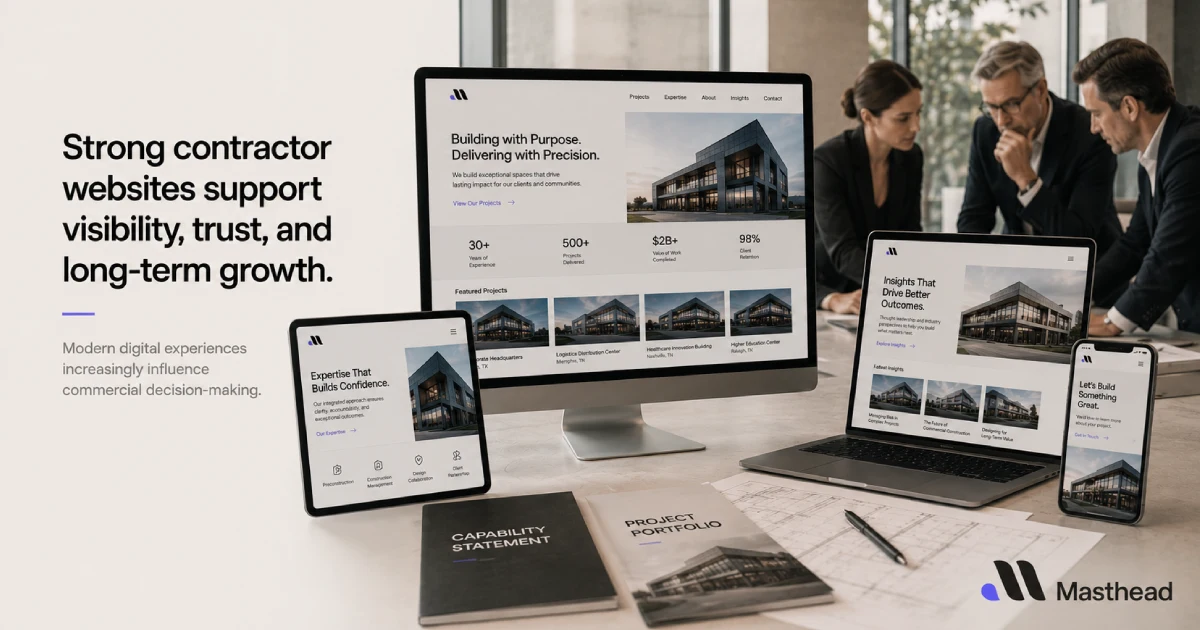
In many cases, a contractor’s website becomes the first introduction to the company.
Unfortunately, many commercial contractors are still relying on websites that were designed for a very different business environment. They may contain outdated project information, weak messaging, poor mobile experiences, or little evidence of the company’s actual capabilities.
The result is a growing disconnect between the quality of the contractor and the quality of the digital experience representing them.
In 2026, that disconnect can be costly.
Commercial Buyers Have Higher Expectations Than Ever
Commercial construction buyers are not making impulse decisions.
Whether they are developers, architects, property managers, municipalities, healthcare organizations, educational institutions, or industrial operators, they are often responsible for projects involving substantial budgets and significant risk.
Their evaluation process is thorough.
They want to understand:
- What types of projects the contractor handles
- Whether the company has relevant experience
- How large and complex previous projects have been
- Whether the contractor appears organized and professional
- How the company compares to competitors
Much of that evaluation now happens online.
A commercial buyer may spend only a few minutes reviewing a contractor’s website, but those few minutes often shape the initial perception of the business. A weak website can raise questions. A strong website can create confidence.
The Website Has Become Part of the Qualification Process
Many commercial contractors still think of their website as a marketing tool.
Increasingly, it functions more like a qualification tool.
Before requesting proposals or scheduling introductory meetings, buyers want reassurance that the contractor is capable of delivering work at the scale and complexity required. A website helps provide that reassurance—or it fails to.
When visitors encounter outdated design, generic messaging, weak project portfolios, or incomplete service information, they may begin questioning whether the company is the right fit for their project.
The contractor may be highly qualified. The website simply fails to communicate it.
Many of the issues discussed in why most construction company websites fail stem from this gap between capability and presentation. Successful commercial contractors understand that their website now supports the same business development efforts that estimators, project executives, and leadership teams work so hard to build.
Commercial Construction Is Different From Residential Construction
One reason many contractor websites struggle is that they are designed as if all construction buyers behave the same way.
They do not.
Residential customers often focus on:
- pricing
- convenience
- reviews
- speed of response
Commercial buyers are usually evaluating different factors.
They care about:
- project experience
- operational maturity
- safety culture
- communication processes
- scalability
- technical capability
- industry expertise
A commercial contractor’s website should reflect those priorities.
It should feel structured, professional, and capable. More importantly, it should communicate confidence rather than simply promote services. Including the right contractor website design features can help communicate those strengths more effectively.
Project Portfolios Matter More Than Ever
One of the fastest ways commercial buyers evaluate contractors is by reviewing previous work.
This is where many contractor websites fall short.
Project pages are often limited to a few photographs and a short description. Yet those projects represent one of the strongest trust-building assets a contractor possesses.
Commercial buyers want to understand:
- What challenges were solved
- What type of facility was involved
- What industries were served
- How large the project was
- What expertise was required
The strongest commercial contractor websites treat project portfolios as case studies rather than galleries. They tell stories, demonstrate capability, and provide evidence that the contractor has completed projects similar to the one being considered.
Modern Buyers Expect Professional Digital Experiences
Construction companies are no longer compared only against other contractors.
Commercial buyers spend their days interacting with sophisticated digital experiences from software companies, engineering firms, manufacturers, and professional service organizations. Those experiences influence expectations.
When a contractor’s website feels outdated, difficult to navigate, or poorly organized, it creates friction. Visitors may not consciously identify every issue. They simply leave with less confidence.
Modern websites should feel:
- easy to navigate
- visually organized
- mobile-friendly
- fast-loading
- professionally branded
Good design is not about appearance alone. It is about making information accessible and reducing uncertainty. This is why responsive web design and usability have become essential components of modern contractor websites.
Visibility Has Become a Competitive Advantage
Even the best website cannot generate opportunities if nobody finds it.
Many commercial contractors continue to rely heavily on referrals, networking, and existing relationships. While those channels remain important, search visibility is becoming increasingly valuable.
Project owners, developers, and procurement teams frequently research:
- commercial contractors
- specialty contractors
- industrial construction firms
- healthcare construction companies
- design-build contractors
The companies that appear during those searches gain opportunities to enter conversations earlier.
Strong SEO is not about chasing traffic. It is about being visible when potential clients are actively evaluating solutions. A contractor with strong visibility often earns consideration before competitors who remain difficult to find online.
The principles outlined in what makes a great construction website in 2026 highlight how visibility and user experience work together to support growth.
Recruiting Has Become Part of the Website’s Job
Commercial contractors are not only competing for projects.
They are competing for talent.
Skilled project managers, superintendents, estimators, engineers, and field personnel increasingly research employers before applying.
An outdated website can create concerns about:
- company culture
- growth opportunities
- professionalism
- stability
A strong website helps support recruiting by showcasing:
- company values
- project experience
- leadership
- culture
- career opportunities
For many firms, recruiting has become just as important as lead generation. A well-designed website can play a major role in attracting candidates, similar to the strategies discussed in how a modern website can help attract and retain top talent.
What High-Performing Commercial Contractors Do Differently
When you look at commercial contractors that consistently present themselves well online, several patterns emerge.
Their websites:
- clearly communicate specialties and capabilities
- showcase meaningful project experience
- explain industries served
- provide strong proof through case studies
- support mobile users effectively
- rank for relevant searches
- make it easy to start conversations
Most importantly, they focus on the buyer.
Rather than talking endlessly about themselves, they help visitors understand how the company can solve problems and deliver successful outcomes. That shift in perspective makes a significant difference.
A Website Is Now Part of Business Development
For many commercial contractors, the website has quietly become one of the most important business development assets they own.
It influences:
- first impressions
- proposal credibility
- recruiting
- search visibility
- partnership opportunities
- trust perception
Unlike networking events, proposal meetings, or sales presentations, the website works continuously.
Potential clients evaluate it at all hours, often before anyone from the company knows they exist. The contractors who recognize this are investing accordingly.
Final Thoughts
Commercial construction remains a people-driven business.
Relationships still matter. Experience still matters. Execution still matters.
But before those strengths can be demonstrated, potential clients often need a reason to start the conversation.
That is where the website comes in.
The best commercial contractor websites do more than describe services. They build confidence, communicate expertise, showcase capability, and reinforce professionalism.
In 2026, that can be the difference between being considered and being overlooked.
To learn more about improving your contractor website, contact our team or visit the Masthead Technology to learn more. .
FAQs
Why do commercial contractors need different websites than residential contractors?
Commercial buyers evaluate different factors, including project experience, operational capability, safety culture, scalability, and technical expertise. Their decision-making process is often more complex and risk-focused.
What should a commercial contractor website include?
A strong commercial contractor website should include detailed service pages, project portfolios, case studies, trust signals, mobile optimization, clear positioning, and SEO-friendly content.
How important are project portfolios for commercial contractors?
Project portfolios are one of the strongest trust-building tools available. They help demonstrate experience, technical capability, and success with similar project types.
Does SEO matter for commercial construction companies?
Yes. Many developers, property owners, and procurement teams research contractors online before reaching out. SEO helps increase visibility during that process.
How often should commercial contractor websites be updated?
Most commercial contractors should review and refresh their website every three to five years to ensure it reflects current capabilities, branding, user expectations, and search requirements.