
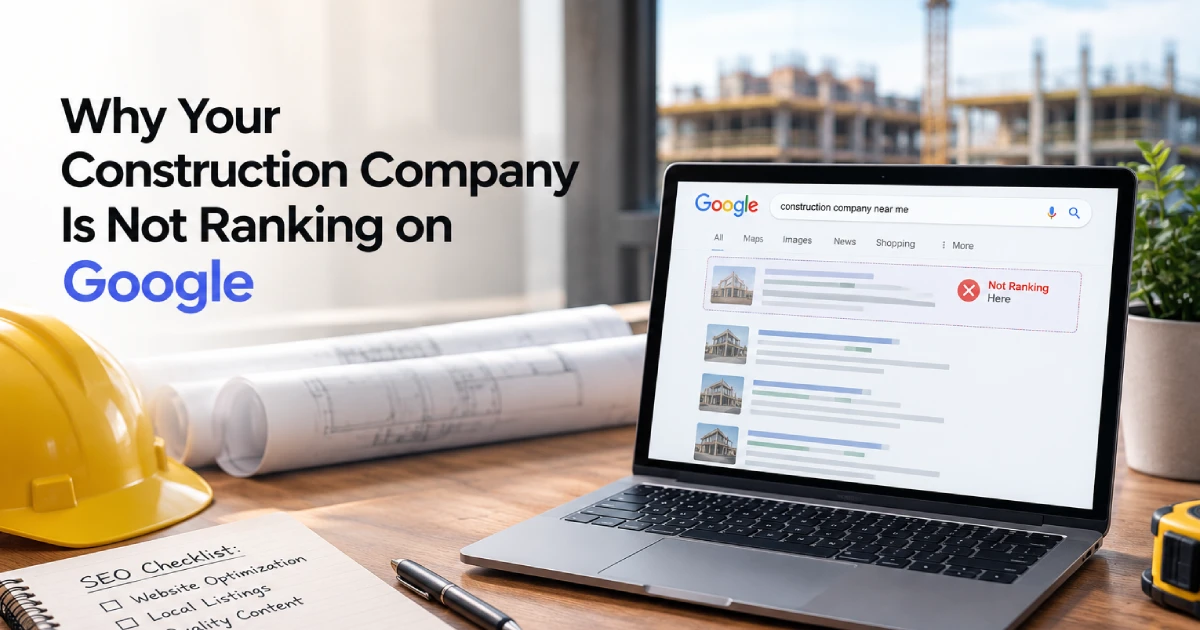
Why Your Construction Company Is Not Ranking on Google
A construction company can have a strong reputation, decades of experience, impressive projects, and a professional website and still struggle to appear on Google for the services it actually wants to sell.
That can be frustrating, especially when smaller competitors seem to appear above you.
But poor rankings are rarely caused by one single issue.
Usually, the problem is a combination of website structure, weak service targeting, limited authority, poor local relevance, thin project content, technical issues, or competition from companies that have simply made their expertise easier for Google to understand.
The right question is not: “Why does Google not like our website?”
It is: “What is missing between what our company does and what the website proves?”
Here are the most common reasons construction companies struggle to rank.
1. Your Website Ranks for Your Company Name but Not Your Services
This is one of the most common situations. Search for the company name and the website appears immediately.
Search for something like:
- commercial contractor
- design-build contractor
- excavation contractor
- industrial construction company
- healthcare construction contractor
- commercial concrete contractor
and the site is nowhere to be found.
That usually means Google understands the brand but not the full scope of the company’s services. Ranking for a company name is relatively straightforward because the search is highly specific. Ranking for a service requires stronger evidence.
Your website has to make it clear:
- what services you provide
- where you provide them
- what markets you serve
- what projects demonstrate those services
- why your company is relevant to that search
If all of that is compressed into a few sentences on the homepage, Google may have very little to work with. For a deeper breakdown of foundational organic strategy, review our comprehensive construction SEO guide.
2. Important Services Do Not Have Their Own Pages
A construction company may offer:
- general contracting
- design-build
- preconstruction
- construction management
- concrete
- sitework
- excavation
- renovations
- structural work
but list all of them on one general services page.
From a user perspective, that may be enough to show capabilities. From a search perspective, it creates a weaker structure. Each important service usually needs enough dedicated information for a prospective client to understand:
- what the company does
- who the service is for
- what types of projects it applies to
- what makes the company qualified
- what related projects prove the capability
A dedicated service page gives Google a clearer destination for that search intent. The goal is not to create a page for every tiny capability. It is to create strong pages for services the company genuinely wants to grow, which is a standard pillar when implementing professional SEO services for construction firms.
3. Your Service Pages Are Too Thin
Having a dedicated page is not automatically enough. A page called Commercial Construction with two paragraphs and a stock image is not necessarily a strong result.
A useful service page should explain the service in enough depth to demonstrate relevance and experience. That can include:
- scope
- process
- project types
- markets
- capabilities
- relevant experience
- locations
- related projects
- FAQs
- next steps
The page should help a prospective client make a decision. If it exists only because someone said, “We need a page for this keyword,” it will usually feel thin to both users and search engines, compounding the issues behind why construction websites fail to generate leads.
4. Your Website Structure Does Not Reflect How Clients Search
Construction companies often organize websites around internal business structure. Searchers do not always think that way.
A prospective client may search by:
- service
- market
- location
- project type
- capability
For example, commercial contractor Lafayette is different from healthcare construction company Louisiana, which is different again from design-build contractor. If the website only has:
- Home
- About
- Services
- Projects
- Contact
it may not provide enough structure to support those different searches. A stronger website often creates clear relationships between:
Services → Markets → Locations → Projects
Tailoring pages to the specific industries you serve makes it easier for search engines and potential clients to understand where the company fits.
5. Your Location Strategy Is Weak
Construction companies often want to rank in multiple cities. The common response is to create pages such as:
- Contractor in City A
- Contractor in City B
- Contractor in City C
- Contractor in City D
The problem is that location pages can become nearly identical. If every page says the same thing with the city name changed, there is little reason for one page to be considered particularly valuable.
Strong location relevance is usually supported by more than a city name. It may include:
- actual projects completed nearby
- local market knowledge
- relevant service coverage
- office information
- team presence
- regional experience
- client relationships
- local case studies
Location pages should demonstrate real relevance, not just geographic targeting.
6. Your Project Pages Are Not Helping Your SEO
Construction companies often have one major advantage over other businesses: they have physical evidence of their work.
But many websites fail to use that evidence properly. A project page that contains only a project name and a photo gallery does not communicate much to Google or a potential client. Integrating structured project portfolio systems solves this by organizing project data with contextual metadata.
A stronger project page may include:
- project type
- location
- market
- services performed
- scope
- challenge
- solution
- outcome
- related services
- related projects
That information creates useful context. A commercial renovation project in New Orleans can reinforce commercial construction, renovation capability, regional relevance, and real-world experience.
7. Your Website Has Too Much Generic Content
Generic construction language is everywhere:
- quality craftsmanship
- trusted professionals
- customer satisfaction
- superior service
- decades of experience
- committed to excellence
These claims are not necessarily wrong; they are just not very specific. Search engines need clearer information, and prospective buyers do too.
Compare:
“We provide quality construction solutions for clients across the region.”
with:
“Our team provides preconstruction, design-build, and commercial general contracting for healthcare, education, and industrial projects across South Louisiana.”
The second statement provides far more operational context. Specificity is essential to how construction companies build trust online.
8. Your Content Targets Traffic Instead of Buyers
A construction company can publish dozens of articles and still struggle to generate useful organic traffic. That happens when the content attracts people who are unlikely to become clients, such as:
- DIY repair topics
- broad home improvement ideas
- generic construction definitions
- unrelated informational topics
That does not mean informational content is useless; it means the content should connect to actual commercial intent.
A better article might answer: “Design-Build vs Design-Bid-Build: Which Delivery Method Fits Your Project?” That topic directly supports a design-build offering and gives readers a clear business path. Traffic without commercial intent does not drive growth.
9. Your Existing Pages Are Competing With Each Other
Sometimes a construction website has too many pages targeting nearly the same idea:
- commercial construction
- commercial contractor
- commercial general contractor
- general construction services
- commercial construction services
If all five pages are similar, search engines may struggle to determine which one should rank—an issue known as keyword cannibalization.
The solution is not always to create more pages. Often, the better move is to:
- merge overlapping content
- strengthen one primary page
- redirect duplicates
- clarify internal linking
- separate genuinely different intents
A cleaner architecture consistently outperforms a cluttered footprint, helping you avoid common construction website mistakes.
10. Your Internal Linking Is Weak
A good service page can still underperform if the rest of the website barely links to it. Internal links demonstrate relationships between content:
- A healthcare construction page should link to relevant healthcare projects.
- A project should link back to the service performed.
- A blog about construction management should link to the construction management service page.
- A location page should connect to services offered in that region.
Think of internal linking as the site’s internal recommendation architecture. If your website does not treat an important page as valuable, search engines will not either.
11. Your Competitors Have Stronger Authority
Sometimes the website itself is reasonably good, but the hurdle is external authority. A competitor may possess:
- more industry links
- more local citations
- more project mentions
- stronger press coverage
- better backlinks
- stronger association memberships
- older domain authority
- more established content
For construction companies, legitimate authority comes from industry publications, trade associations, project partners, manufacturers, suppliers, awards, chambers of commerce, and local news coverage.
The objective should be credible industry relevance rather than low-quality link schemes, allowing established construction firms to compete online effectively.
12. Your Website Has Technical SEO Problems
Technical issues can limit visibility even when your content is strong. Common problems include:
- pages blocked from indexing
- broken redirects
- duplicate pages
- incorrect canonical tags
- slow performance
- mobile usability problems
- broken internal links
- missing XML sitemap updates
- outdated plugins
- poor page rendering
- accidental noindex settings
Routine maintenance and dedicated website support ensure technical issues do not quietly suppress indexing and rank performance.
13. Your Website Was Redesigned Without an SEO Migration Plan
This deserves special attention. A new website may look dramatically better and still lose organic visibility if the transition is mismanaged. That often happens when:
- old URLs are removed
- page slugs change
- redirects are missing
- content is shortened
- valuable pages disappear
- internal links change
- metadata is lost
- project pages are replaced
- site structure is simplified too aggressively
Following a structured construction website redesign guide prevents search equity loss during major transitions. Before launching, identify which URLs hold traffic, rankings, and backlinks so they can be mapped to 301 redirects seamlessly.
14. Your Google Business Profile and Website Are Not Supporting Each Other
For locally focused contractors, organic search and local map visibility are related but distinct channels. A company may rank in traditional search while being invisible in Google Maps, or vice versa.
Local visibility depends on:
- Google Business Profile optimization
- business categories
- reviews and ratings
- location relevance
- NAP (Name, Address, Phone) consistency
- proximity
- website relevance
- local authority
Website optimization and local map strategies must reinforce one another rather than operate in silos.
15. Your Website Does Not Show Enough Local Proof
A contractor may claim to serve an entire region but show almost no evidence of actual work there. That creates a credibility gap for both potential clients and search engines.
Local project evidence can help. For example, a contractor targeting Baton Rouge should ideally have real evidence connected to Baton Rouge where available:
- projects
- client work
- office information
- service history
- regional experience
This provides tangible validation rather than an empty geographic claim.
16. You Are Targeting Keywords That Are Too Broad
A contractor might want to rank for construction company. But that search is extremely broad. Someone searching it could want:
- residential construction
- commercial construction
- employment
- general information
- companies anywhere in the country
More specific, high-intent phrases offer much higher commercial return:
- commercial construction company Lafayette LA
- industrial design-build contractor Louisiana
Lower search volume does not mean lower business value; the best keywords are those closest to the contracts you actually want to close.
17. Nobody Is Looking at Search Console Data
SEO tools are useful. But Google Search Console shows something particularly valuable: the searches where Google is already testing your website. This data highlights opportunities sitting in positions:
- 4–10
- 11–20
- 20–30
If a high-value service page sits at position 12 with hundreds of impressions, refining that existing asset will produce a faster return than drafting an unrelated post from scratch. Search Console also identifies query demand, click-through rates, and query cannibalization across your pages.
18. You Keep Publishing New Content Instead of Improving Existing Opportunities
More content is not always the answer. If your core service pages sit between positions 8 and 19, publishing eight new blog posts is far less effective than optimizing the revenue-driving pages that are already on the verge of page one.
- When a site has no footprint, developing foundational structure and content is essential.
- When pages sit in positions 11–30, on-page optimization, content depth, and internal linking take priority.
- When pages sit in positions 4–10, competitive SERP analysis, conversion optimization, and authority building drive the final push.
Align your effort with where the actual opportunity sits.
19. Your SEO Strategy Is Disconnected From Business Priorities
A website can improve its rankings while the business receives no meaningful benefit. That happens when SEO focuses on searches the company does not care about. For instance:
- residential search queries ranking for a commercial general contractor
- low-margin service requests crowding out high-value design-build projects
- leads arriving from outside your target geographic footprint
Search strategy must follow business goals. Before executing content plans, define which service lines, markets, project sizes, and regions drive your balance sheet, and orient technical structure to match. Poor alignment is a primary reason why most construction company websites fail to deliver ROI.
How to Diagnose Why Your Construction Company Is Not Ranking
Instead of guessing, work through the problem systematically.
- Step 1: Search Your Company Name — If you do not rank for your own brand, investigate technical and indexing issues first.
- Step 2: Search Your Core Services — Check whether the website appears for the services that drive revenue.
- Step 3: Review Search Console — Look at impressions, clicks, positions, and queries to identify where Google is already testing the site.
- Step 4: Review Your Service Pages — Ask: Does each priority service have a dedicated page? Is it useful? Does it feature relevant projects?
- Step 5: Review Location Coverage — Determine whether the site demonstrates actual relevance to the areas being targeted.
- Step 6: Review Projects — Check whether completed work reinforces services, markets, and locations.
- Step 7: Compare Competitors — Identify what companies ranking above you have that you do not (signals, proof, structure).
For a deeper dive into these execution steps, consult our comprehensive construction SEO guide.
You May Not Need More Content
If your construction company is not ranking, adding twenty more articles is rarely the fix. The real solution usually lies in:
- comprehensive service pages
- structured project proof
- cohesive internal linking
- clean technical infrastructure
- targeted local relevance
- high-intent website architecture
Diagnose where the search journey breaks down before committing resources.
Masthead Technology delivers specialized website design services for construction firms alongside tailored construction seo services by evaluating the entire commercial search architecture: capabilities, target markets, project history, and platform structure.
If your website isn’t bringing in the project inquiries your experience warrants, contact our team to evaluate your digital footprint and build an architecture that ranks.