
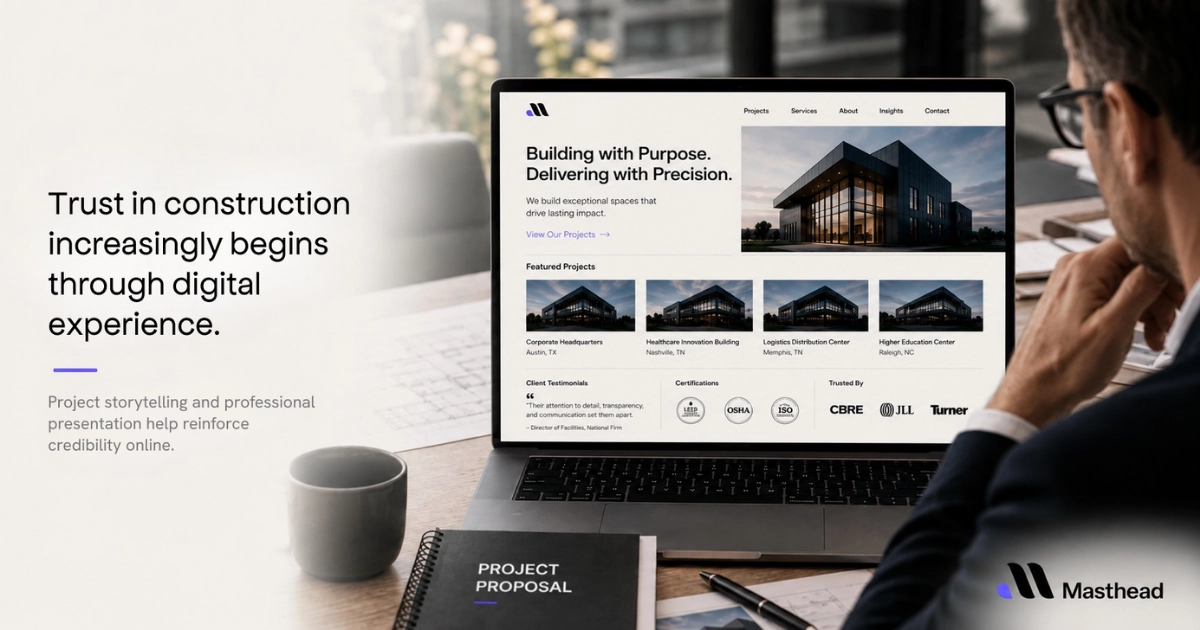
Trust has always been one of the most valuable assets in the construction industry.
Long before contracts are signed, budgets are approved, or projects break ground, clients are making judgments about whether a contractor is capable of delivering what they promise.
Historically, trust was built through referrals, relationships, reputation, and years of successful project execution.
Those factors still matter.
What has changed is where trust-building begins.
In 2026, many potential clients encounter a construction company online before they ever speak with a project manager, estimator, or business development representative. They visit websites, review portfolios, compare competitors, read testimonials, and evaluate companies from a distance.
As a result, trust is no longer built exclusively through personal relationships. It is increasingly built through digital experiences.
The contractors that understand this are creating significant advantages over competitors whose online presence fails to communicate their true capabilities.
Trust Is Really About Reducing Risk
When a client hires a contractor, they are taking a risk.
Construction projects involve substantial investments, tight schedules, multiple stakeholders, and significant operational complexity.
Whether the client is a developer, property manager, healthcare organization, municipality, or industrial operator, they are looking for reassurance that they are making the right decision.
That is why trust matters so much.
Potential clients are constantly asking themselves questions such as:
- Can this company handle a project like ours?
- Do they have relevant experience?
- Will they communicate effectively?
- Are they organized?
- Will they deliver what they promise?
Trust is built when those questions are answered clearly and consistently.
The role of a contractor’s website is not simply to provide information. Its role is to reduce uncertainty. Many of the reasons discussed in why most construction company websites fail stem from a failure to build confidence and reduce perceived risk.
First Impressions Happen Long Before Meetings
Most contractors assume trust begins during conversations.
In reality, many impressions are formed much earlier.
Imagine a developer researching contractors for an upcoming project. They visit several websites in a single afternoon.
One contractor presents detailed project experience, clear service information, strong branding, and a professional digital experience. Another has an outdated website with limited project information and generic messaging.
Both companies may be equally qualified.
Yet one immediately feels more trustworthy.
This happens because people often use visible signals to make judgments about credibility. A website becomes one of those signals.
Before a meeting is scheduled, visitors are already deciding whether a company appears organized, professional, and capable. This is one of the core principles behind what makes a great construction website in 2026.
Project Portfolios Are One of the Strongest Trust Signals
Construction is an industry built on proof.
Clients do not simply want to hear what a contractor can do. They want evidence.
That is why project portfolios remain one of the most powerful trust-building tools available.
Unfortunately, many contractor websites fail to maximize their value. Projects are often presented as simple photo galleries with minimal context.
The strongest construction websites take a different approach. They help visitors understand:
- What type of project was completed
- What challenges were involved
- How the contractor solved those challenges
- What expertise was required
- What outcomes were achieved
This transforms a project portfolio into something much more meaningful.
Instead of simply displaying completed work, it demonstrates capability. The more relevant a project appears to a potential client’s needs, the more trust it creates.
Specificity Creates Confidence
Many construction websites rely on broad marketing language.
Visitors see statements such as:
- “We deliver quality workmanship.”
- “We prioritize customer satisfaction.”
- “We provide trusted construction solutions.”
While these messages are positive, they rarely help clients understand what makes a contractor unique.
Trust grows when companies are specific. Clients want clarity about:
- Industries served
- Project types completed
- Geographic markets covered
- Areas of specialization
- Delivery methods
- Team expertise
Specific information helps visitors determine whether a contractor is genuinely qualified for their project.
The more clearly a company communicates its strengths, the easier it becomes for potential clients to feel confident.
Trust Is Reinforced Through Transparency
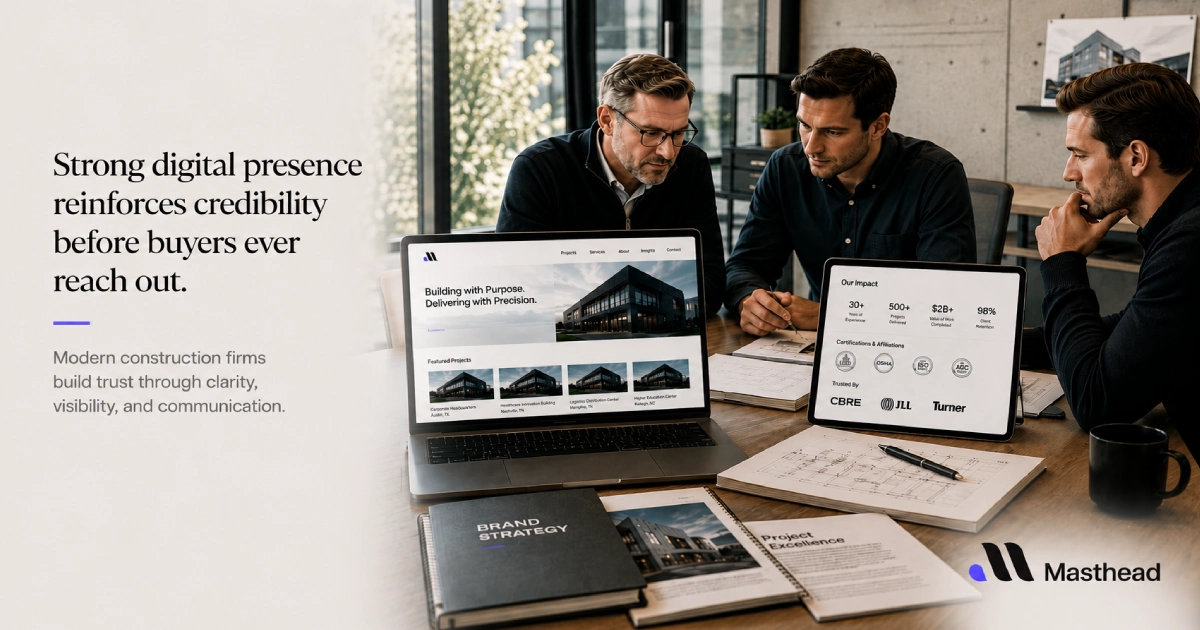
One of the most overlooked trust-building factors is transparency.
People trust companies that appear open, honest, and confident in their capabilities.
Strong construction websites often provide information about:
- Leadership teams
- Company history
- Safety programs
- Certifications
- Industry affiliations
- Project processes
- Core values
This information helps humanize the organization.
Rather than feeling like an anonymous company, the contractor becomes a group of real professionals with visible expertise and accountability.
Transparency helps reduce perceived risk, and reducing risk is one of the fastest ways to build trust. Companies that invest in modern digital experiences often see the same benefits discussed in why commercial contractors need better websites.
Client Testimonials Still Matter
Construction buyers often place significant value on what previous clients have to say.
Testimonials provide social proof. They reassure visitors that others have trusted the company and achieved positive outcomes.
However, generic testimonials often have limited impact.
Statements like “Great company” or “Highly recommended” provide little context.
The strongest testimonials explain:
- The type of project completed
- The client’s experience
- Specific challenges addressed
- Results achieved
- Why the client would work with the contractor again
Detailed testimonials feel more authentic and more credible. They help prospective clients imagine what it would be like to work with the contractor themselves.
A Professional Website Experience Builds Confidence
Trust is not built solely through content.
It is also influenced by the overall experience.
Visitors notice when websites are:
- Difficult to navigate
- Slow to load
- Poorly organized
- Outdated in appearance
- Frustrating on mobile devices
Even if they do not consciously identify every issue, these problems affect perception.
A professional website communicates professionalism. A confusing website creates doubt.
The strongest contractor websites feel organized, intentional, and easy to use. That experience reinforces the impression that the company itself operates in a similar way.
Businesses still relying on older digital experiences often encounter the challenges outlined in Why Old Contractor Websites Hurt Trust.
Visibility Supports Trust
Trust cannot be built if potential clients never find the company.
This is where search visibility becomes important.
When contractors consistently appear in relevant search results, they gain additional credibility. Buyers often assume that visible companies are established and active within their markets.
Strong SEO helps support trust by increasing exposure during the research process.
Combined with a strong website experience, visibility allows contractors to build credibility long before direct conversations begin. Companies that improve visibility often generate more opportunities and avoid the challenges described in construction firms losing RFQs because of their websites.
Trust Extends Beyond Clients
Many construction companies focus exclusively on client trust.
However, websites also influence:
- Potential employees
- Industry partners
- Architects
- Engineers
- Investors
- Vendors
Every visitor is evaluating the company in some way.
A strong digital presence helps reinforce confidence across all of these audiences. That broader impact is one reason websites have become increasingly important business assets.
A professional website can also support hiring efforts, similar to the benefits discussed in how a modern website can help attract and retain top talent.
What High-Trust Construction Websites Have in Common
When reviewing contractor websites that consistently create positive impressions, several themes appear repeatedly.
They communicate expertise clearly.
They showcase relevant project experience.
They provide meaningful proof rather than generic claims.
They make information easy to access.
They feel modern without being overly promotional.
Most importantly, they focus on helping visitors feel confident.
Trust is not created through flashy design.
It is created through clarity, credibility, and consistency.
Final Thoughts
Construction companies have always relied on trust to win work.
The difference in 2026 is that trust increasingly begins online.
Before proposals are requested, before meetings occur, and before contracts are negotiated, potential clients are evaluating contractors digitally.
The strongest construction websites recognize this reality. They do not simply describe services. They actively reduce uncertainty, communicate expertise, showcase proof, and reinforce credibility.
As buyer behavior continues to evolve, companies that invest in building trust online will be better positioned to earn opportunities, strengthen relationships, and compete more effectively.
If you’d like to improve how your company builds trust online, contact our team or visit Masthead Technology to learn more.
FAQs
Why is trust so important in construction marketing?
Construction projects involve significant financial investment and operational risk. Clients want confidence that a contractor can successfully deliver the project before making a commitment.
What website elements help build trust?
Project portfolios, case studies, testimonials, certifications, leadership information, safety credentials, and professional design all contribute to trust-building.
Are project portfolios more important than testimonials?
Both matter, but project portfolios often provide stronger evidence because they demonstrate actual experience and capability through completed work.
How does website design affect trust?
A professional, organized, and easy-to-use website creates confidence and reinforces the perception that the company operates professionally.
Can SEO help build trust?
Yes. Visibility in search results increases exposure and often reinforces credibility during the research and evaluation process.