
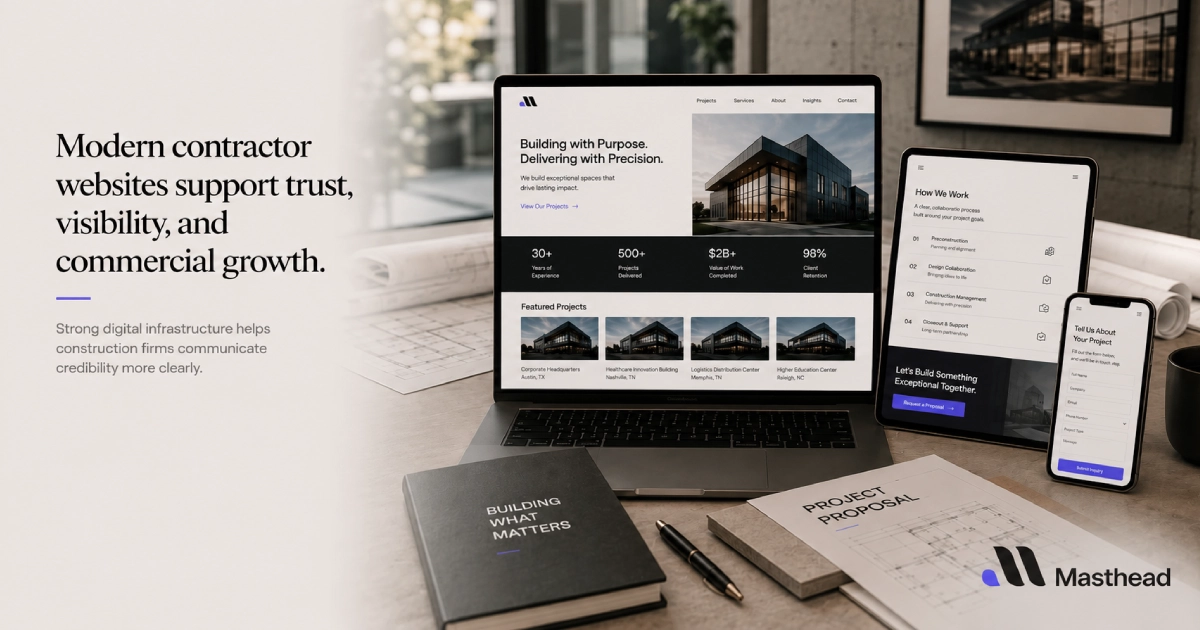
Construction Firms Are Losing RFQs Because of Their Websites
Most construction executives assume they lose projects for familiar reasons.
Perhaps the winning contractor had a lower price. Maybe they had a stronger relationship with the client. Sometimes the competitor simply had more relevant experience.
Those factors certainly matter.
However, an increasing number of construction firms are overlooking another influence that affects whether they are even invited into the conversation: their website.
In 2026, commercial buyers conduct extensive research before requesting proposals or issuing Requests for Qualifications (RFQs). Long before estimators, business development teams, or project executives become involved, potential clients are evaluating contractors online.
They are comparing experience, reviewing project portfolios, assessing professionalism, and deciding which firms appear most capable of delivering successful outcomes.
For many construction companies, the website has become part of the selection process.
The problem is that many contractor websites still operate as if nothing has changed. They provide basic information but fail to communicate the expertise, credibility, and operational strength that buyers are looking for.
As a result, some firms are quietly losing RFQ opportunities without ever realizing why.
The RFQ Process Starts Earlier Than Most Contractors Realize
Many contractors think the RFQ process begins when the document arrives.
In reality, it often begins weeks or months earlier.
Before formal qualification requests are issued, project owners, developers, architects, engineers, and procurement teams are researching potential partners.
They are building shortlists.
They are narrowing options.
They are identifying companies they believe are worth considering.
Increasingly, that research happens online.
A contractor’s website becomes one of the first places buyers look for answers. They want to know:
- Has this company completed projects like ours?
- Do they understand our industry?
- Are they large enough to handle the work?
- Do they appear organized and professional?
- Can they be trusted with a significant investment?
When those answers are difficult to find, buyers often move on.
Not because the contractor lacks capability, but because the website fails to communicate it effectively.
Commercial Buyers Are Evaluating Risk
Construction projects involve substantial budgets, complex coordination, and long-term commitments.
Every contractor selection carries risk.
That is why commercial buyers spend significant time evaluating potential partners before inviting them into the bidding process. They are not simply looking for companies that can perform the work. They are looking for companies that inspire confidence.
A website plays an important role in that assessment.
When a website feels outdated, difficult to navigate, or incomplete, it can create unnecessary uncertainty. Buyers may begin asking questions they otherwise would not have considered:
- Is the company still growing?
- Do they invest in their business?
- Are their systems modern?
- Will communication be organized?
The website may not provide definitive answers, but it strongly influences perception.
Many of the concerns discussed in why old contractor websites hurt trust directly affect how commercial buyers evaluate risk and determine which contractors deserve further consideration.
Weak Project Portfolios Make Qualification Difficult
One of the most common reasons construction websites underperform is weak project presentation.
Commercial buyers want proof. They want evidence that a contractor has completed projects similar to the one being planned.
Unfortunately, many websites provide only limited information. A visitor may see a few photographs and a brief project title, but very little context.
That makes qualification difficult.
Strong project portfolios help buyers understand:
- Project size and scope
- Industry experience
- Technical complexity
- Geographic reach
- Construction capabilities
- Relevant expertise
The strongest construction websites treat project pages as business development assets. They explain challenges, solutions, outcomes, and lessons learned.
This transforms a portfolio from a gallery into a credibility-building tool.
Many Contractor Websites Focus on the Wrong Information
A surprising number of construction websites spend more time talking about the company than helping buyers evaluate fit.
Visitors encounter pages dedicated to company history, mission statements, and generic marketing language. Meanwhile, the information buyers actually want is difficult to find.
Commercial decision-makers are typically more interested in:
- Relevant experience
- Project capabilities
- Industries served
- Team expertise
- Safety performance
- Delivery processes
The most effective websites are built around buyer questions rather than company descriptions.
They help visitors quickly understand whether the contractor is a strong match for the project being considered. This buyer-focused approach is one of the principles discussed in what makes a great construction website in 2026.
Outdated Websites Create Questions About Professionalism
Most contractors would never submit an RFQ response that looked unprofessional.
Yet many unknowingly present themselves through websites that do exactly that.
An outdated website may contain:
- Old project photos
- Inconsistent branding
- Poor mobile usability
- Broken pages
- Slow loading times
- Generic content
Individually, these issues may seem minor.
Collectively, they influence how the company is perceived.
Commercial buyers often associate digital professionalism with operational professionalism. A website that feels neglected can make a company appear less organized, less current, or less sophisticated than competitors.
That perception can influence who receives an invitation to participate in the RFQ process. Many of these issues are common reasons construction company websites fail to generate meaningful business opportunities.
Search Visibility Impacts Who Makes the Shortlist
In many cases, contractors lose opportunities before a buyer even visits their website.
The problem is visibility.
Developers, architects, facility owners, and procurement teams frequently search for contractors online while researching potential partners. They may search for:
- Commercial construction companies
- Healthcare contractors
- Industrial builders
- Concrete contractors
- Design-build firms
- Specialty trade contractors
If a company does not appear during that research process, it may never be considered.
Strong SEO is not simply about generating traffic. It is about being visible when qualification decisions are being formed.
The firms that consistently appear in search results often gain an advantage long before RFQs are issued. This is one of the reasons highlighted in why commercial contractors need better websites.
The Website Has Become Part of Business Development
Traditionally, business development relied heavily on networking, referrals, industry relationships, and in-person meetings.
Those channels remain important.
However, websites increasingly support those efforts.
A strong website helps reinforce:
- Credibility
- Experience
- Capability
- Professionalism
- Market positioning
It provides reassurance after a referral. It strengthens confidence before a meeting. It supports proposal efforts by showcasing relevant experience and expertise.
In many ways, the website now works alongside business development teams rather than separately from them.
What High-Performing Construction Websites Do Differently
When reviewing contractor websites that consistently support RFQ generation, several patterns emerge.
They focus on helping buyers evaluate confidence.
They clearly communicate:
- Industries served
- Project experience
- Service capabilities
- Geographic reach
- Team expertise
Their project portfolios tell meaningful stories.
Their service pages provide depth rather than broad descriptions.
Their websites load quickly, perform well on mobile devices, and make it easy for visitors to take the next step.
Most importantly, every element is designed to reinforce credibility and build trust.
RFQs Are Won Before They Are Issued
This idea may sound surprising, but many qualification decisions begin long before formal documentation is distributed.
By the time RFQs are sent, buyers often already have strong opinions about which firms they trust most.
Those opinions are shaped through:
- Referrals
- Previous relationships
- Industry reputation
- Online research
- Website experiences
A contractor’s website cannot replace experience or relationships.
But it can strengthen them.
And increasingly, it can determine whether a company is invited into the conversation at all.
Final Thoughts
Construction firms rarely lose RFQs because of a single issue.
More often, opportunities are lost through a series of small impressions that gradually influence buyer confidence.
An outdated website, weak project portfolio, poor visibility, or unclear positioning may not seem significant on their own. Together, however, they can affect whether a contractor appears qualified, credible, and worth considering.
In 2026, websites are no longer passive marketing assets.
They are active participants in how commercial buyers evaluate construction firms.
The companies that recognize this are positioning themselves more effectively to earn trust, generate opportunities, and compete for larger projects.
If you’re ready to improve your online presence, contact our team or visit Masthead Technology to learn more.
FAQs
Can a website really affect RFQ opportunities?
Yes. Many commercial buyers research contractors online before issuing RFQs or requesting proposals. A website often influences whether a company is included on a shortlist.
What information do buyers look for on contractor websites?
Buyers typically want to see project experience, industries served, service capabilities, team expertise, safety credentials, and evidence of successful project delivery.
Why are project portfolios important for RFQs?
Project portfolios help buyers evaluate whether a contractor has relevant experience with projects similar in scope, complexity, or industry.
How does SEO impact RFQ generation?
SEO helps construction companies appear during the research phase when buyers are identifying potential contractors and building qualification lists.
What are the biggest website issues that hurt contractor credibility?
Common issues include outdated design, weak project portfolios, poor mobile usability, generic messaging, slow performance, and limited search visibility.